
SLA Tiers for Video Infrastructure: 2026 Guide
SLA tiers for video infrastructure define the contractual levels of availability, performance, and support that determine whether your video extraction and delivery pipeline holds up under real production load. For AI labs, transcription SaaS platforms, and podcast tools pulling content from YouTube, TikTok, or Instagram at scale, a vague uptime promise is not a service agreement. It is a liability. The industry standard sits at 99.9% uptime per calendar month, but the gap between that number and actual reliability depends entirely on how the SLA is structured beneath it.
1. SLA tiers for video infrastructure: uptime guarantees explained
Standard SLA uptime targets of 99.9% allow up to 43.2 minutes of unplanned downtime per month, or nearly 9 hours annually. That math matters. If your AI training pipeline runs nightly batch extractions, 9 hours of annual downtime is not an abstract number. It is missed jobs, corrupted datasets, and manual recovery work.
Uptime is measured differently across vendors. Some calculate it per region, others per request, and some exclude scheduled maintenance windows entirely. A vendor claiming 99.9% uptime while reserving 4-hour weekly maintenance windows is effectively offering far less than the headline number suggests.

Credit tiers and SLA processes vary significantly across providers and directly affect your financial remedies when downtime occurs. A credit of 10% of monthly fees for a 2-hour outage rarely covers the actual business cost of a failed extraction run.
Pro Tip: Read the fine print on what counts as "downtime." Many SLAs exclude incidents caused by third-party platforms, DNS failures, or upstream network issues. For video extraction infrastructure, those exclusions can swallow most real-world failure scenarios.
2. performance and latency SLA tiers: beyond uptime
Most vendor SLAs cover infrastructure availability but omit delivery performance metrics entirely. That gap is where AI workflows break silently. Your pipeline may be "up" while re-buffering rates spike, transcoding queues back up, or time-to-first-frame balloons past acceptable thresholds.
The performance metrics that belong in any serious video infrastructure SLA include:
- Re-buffering rate: The percentage of playback time spent buffering. Enterprise-grade SLAs target below 1%.
- Time-to-first-frame (TTFF): How quickly the first video frame is delivered after a request. Critical for real-time extraction workflows.
- Transcoding turnaround time: The elapsed time from ingest to processed output. Relevant for any pipeline normalizing formats before storage.
- End-to-end latency: High-performance video infrastructures budget for 1.5–4 seconds for stable internet delivery. Sub-500ms latency is reserved for specialized WebRTC use cases.
These metrics directly affect AI processing reliability. A transcription model fed a stream with high re-buffering rates produces degraded output. A dataset pipeline with unpredictable TTFF creates uneven batch sizes and downstream inconsistencies.
Pro Tip: Demand telemetry access as part of your SLA. If a vendor cannot show you real-time re-buffering rates and TTFF data per region, they cannot prove they are meeting performance commitments.
3. support tiers: response times and escalation paths
Support response times during critical incidents are often more operationally important than the uptime percentage itself. A P1 incident resolved in 15 minutes causes less damage than a P2 incident that sits in a ticket queue for 6 hours.
Support tiers in video infrastructure SLAs typically follow this structure:
- Standard (email/ticket): Response within 24–48 hours. Suitable for development environments or low-criticality workloads.
- Priority: Response within 4 hours for P1 incidents. Includes phone or chat access. Appropriate for production workloads with moderate business impact.
- Enterprise: 24/7 direct access to senior technical personnel with defined escalation paths. Response times of 15–30 minutes for P1. Required for live events, real-time extraction, and AI training pipelines with hard deadlines.
Severity mapping matters as much as response time targets. A P1 definition that requires "complete service unavailability" before triggering the fastest response tier leaves significant incidents in slower queues. Broadcast business cycles demand 24/7 support and defined escalation paths that go beyond uptime metrics alone.
Pro Tip: Ask vendors to show you their documented escalation procedure. If they cannot produce a written runbook for P1 incidents, the enterprise support tier is a label, not a commitment.
4. redundancy and recovery SLA tiers: RTO, RPO, and failover
Redundancy at storage, transcoding, and delivery layers is what separates stated uptime from real reliability. A vendor with a single CDN origin and no automatic retry logic can hit 99.9% uptime on paper while delivering a degraded experience during the 0.1% that matters most to your pipeline.
The two recovery metrics that belong in every mission-critical SLA are Recovery Time Objective (RTO) and Recovery Point Objective (RPO). Carrier-grade streaming platforms target an RTO of a few minutes and an RPO of zero, meaning no transactional data is lost during a failover event. For AI extraction workflows, an RPO of zero means no extraction jobs are silently dropped during an origin switch.
| Redundancy Feature | Single CDN | Multi-CDN with Failover |
|---|---|---|
| Origin failover | Manual or none | Automatic, sub-minute |
| Transcoding resiliency | Single pipeline | Parallel pipelines |
| Geographic coverage | Limited | Multi-region |
| Effective uptime | Matches stated SLA | Exceeds stated SLA |
| RPO during failover | Variable | Near zero |
Multi-CDN orchestration introduces operational overhead and should be adopted only when QoE telemetry proves the benefit. The decision to move to multi-CDN should come from measured steering outcomes, not from scale assumptions alone.
Pro Tip: When reviewing a vendor proposal, ask specifically which layers carry redundancy: storage, transcoding, and delivery. A vendor with CDN redundancy but a single transcoding pipeline still has a critical single point of failure.
5. monitoring and observability SLA tiers
Monitoring commitments belong in the SLA, not just in the vendor's internal runbook. Advanced monitoring should separate manifest and segment policies, track AV sync, and create service-level objectives per geography and device type to catch silent failures. Silent failures are the most dangerous failure mode for AI pipelines. The extraction appears to succeed, but the output is incomplete or malformed.
An observability SLA should specify what the vendor monitors, how often, and what triggers an alert to your team. Vendors that offer only aggregate uptime dashboards leave you blind to per-request failures, regional degradation, and format-level errors. For video extraction at scale, per-request reliability data is the only metric that maps directly to your pipeline's actual success rate.
The video API reliability conversation has shifted from "is the service up?" to "did every request succeed?" That shift requires SLA language that covers extraction success rates, not just infrastructure availability.
6. choosing the right SLA tier for your use case
Matching SLA tier to use case is a budget and risk decision, not a prestige decision. Overpaying for enterprise SLAs on a development environment wastes money. Underpaying for a standard tier on a live AI training pipeline creates operational risk.
Here is a practical framework by workload type:
- Small-scale or development: Standard uptime SLA (99.9%), email support, no redundancy requirement. Acceptable for testing and low-volume extraction.
- Production VOD or batch AI extraction: Priority support with 4-hour P1 response, 99.95% uptime, origin failover at the transcoding layer. The bulk video downloader API tier fits here.
- Live events or real-time AI workflows: Enterprise support with 15-minute P1 response, 99.99% uptime, multi-CDN delivery, RTO under 5 minutes, and contractual performance SLAs covering TTFF and re-buffering.
- Compliance or broadcast recording: Full redundancy SLA covering evidence export turnaround and recording completeness, 24/7 support, and defined escalation aligned to broadcast business cycles.
When multi-CDN and advanced recovery SLAs become ROI-positive depends on your cost of downtime. If a 1-hour extraction failure costs more than the annual premium for an enterprise SLA, the math is straightforward. The multi-cloud storage decision follows the same logic: adopt it when telemetry proves the benefit, not before.
Key takeaways
Reliable video infrastructure SLAs require contractual commitments across uptime, performance, redundancy, and support, not just a headline availability percentage.
| Point | Details |
|---|---|
| Uptime math is deceptive | 99.9% uptime still allows 43.2 minutes of monthly downtime; check maintenance exclusions. |
| Performance metrics belong in SLAs | Demand contractual commitments for re-buffering rates, TTFF, and transcoding turnaround. |
| Support tier determines incident cost | Enterprise SLAs with 15-minute P1 response prevent more damage than uptime credits recover. |
| Redundancy exceeds stated uptime | Multi-CDN with origin failover and parallel transcoding delivers reliability beyond the SLA number. |
| Match tier to workload risk | Live AI pipelines require enterprise SLAs; development environments do not. |
Why most teams negotiate the wrong SLA clauses
I have reviewed a lot of vendor SLA documents, and the pattern is consistent. Teams spend 80% of their negotiation energy on the uptime percentage and almost none on the clauses that actually determine their operational experience. A vendor moving from 99.9% to 99.95% uptime in a contract sounds like a win. In practice, it reduces your allowed monthly downtime from 43 minutes to 21 minutes. That is not the clause that saves your pipeline during a real incident.
The clauses that matter are the ones covering what counts as downtime, how P1 severity is defined, whether performance metrics are contractually bound, and what the escalation path looks like at 2 AM on a Sunday. I have seen teams running frontier AI video datasets on standard ticketing support because nobody asked whether the vendor offered anything else.
The shift toward AI-driven video processing is raising SLA expectations across the board. Extraction success rate, not just infrastructure availability, is becoming the metric that matters. A service that is "up" but returning malformed video files or silently dropping requests is not meeting its obligation to your pipeline. Push vendors to include per-request success rate commitments alongside traditional availability metrics. That is where the real SLA conversation is heading.
— Alexandre
How Tornadoapi delivers on high-tier SLA commitments
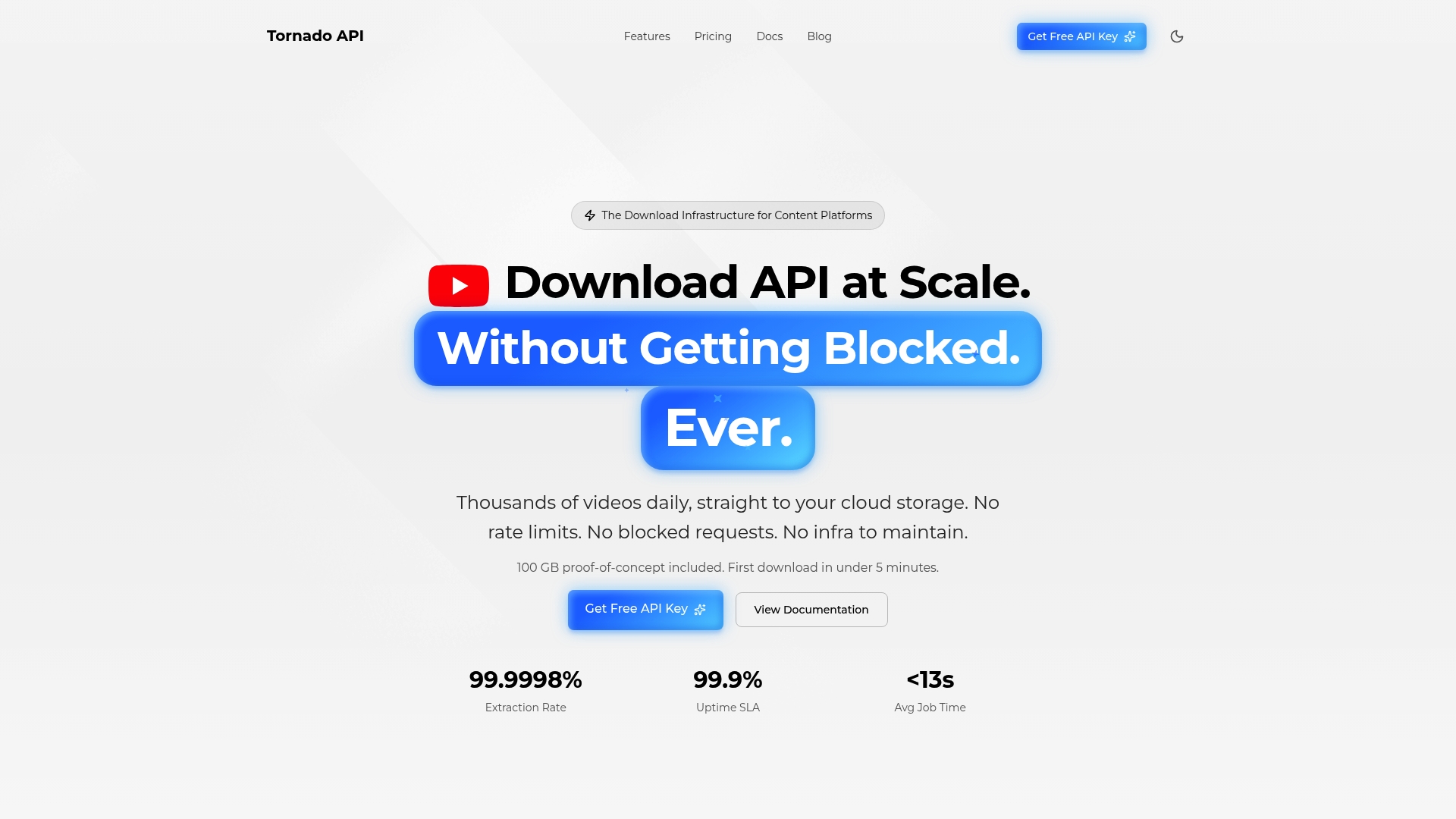
Tornadoapi is built specifically for the SLA expectations that AI video workflows demand. The platform delivers 300 TB per month at 99.998% extraction reliability measured in production, with 50 Gbps capacity and direct cloud delivery to S3, R2, GCS, and Azure. Anti-bot handling and proxy rotation are managed infrastructure, not tools you configure. Support is matched to business criticality, not a generic ticketing queue. Teams replacing general-purpose scraping tools with Tornadoapi get a contractual SLA on reliability, not a toolbox to manage. Explore production-scale extraction tiers or the video clipping infrastructure to see how SLA tiers map to your specific workload.
FAQ
What does 99.9% uptime mean in practice?
99.9% uptime allows up to 43.2 minutes of unplanned downtime per month, or nearly 9 hours annually. Scheduled maintenance windows are often excluded from this calculation, so the real available time can be lower.
What performance metrics should a video infrastructure SLA cover?
A strong SLA covers re-buffering rate, time-to-first-frame, transcoding turnaround time, and end-to-end latency. Most vendor SLAs omit these metrics entirely, which creates untracked failure modes for AI processing pipelines.
What is the difference between RTO and RPO in a video SLA?
Recovery Time Objective (RTO) is how quickly service is restored after a failure. Recovery Point Objective (RPO) is how much data or how many transactions can be lost. Carrier-grade platforms target an RTO of minutes and an RPO of zero.
When does a multi-cdn SLA become worth the cost?
Multi-CDN orchestration adds operational overhead and is worth adopting only when QoE telemetry proves measurable improvement. For live AI extraction or broadcast workloads, the redundancy benefit typically justifies the cost.
How do support tiers differ across video infrastructure vendors?
Support tiers range from standard email ticketing to enterprise 24/7 access with direct escalation to senior engineers. Enterprise tiers define response times by severity level, typically 15–30 minutes for P1 incidents.