
How R2 Storage Differs from S3 for Video Workflows
If you're serving video at any meaningful scale, the storage layer is where your budget either holds or bleeds. Understanding how R2 storage differs from S3 for video is not an academic exercise. For a platform pushing 10TB per month, the wrong choice adds thousands of dollars in egress fees alone. Most engineers assume object storage is object storage. It isn't. Cloudflare R2 and AWS S3 share an API surface but diverge sharply on pricing models, feature depth, and ecosystem fit. This breakdown gives you the specifics to make the right call.
Table of Contents
- Key Takeaways
- How R2 storage differs from S3 for video: cost structure
- Storage classes and features that matter for video
- Performance and technical considerations
- When to choose R2 vs S3 for video
- My honest take after watching teams make this choice
- Scale your video extraction with Tornadoapi
- FAQ
Key Takeaways
| Point | Details |
|---|---|
| Egress is the biggest cost lever | R2 charges zero egress fees vs. S3's $0.09/GB, saving ~$900/month at 10TB served. |
| S3 wins on storage class depth | S3 offers 6+ tiers including Glacier Deep Archive; R2 has two classes with no deep archive option. |
| R2 migration is straightforward | Most S3 SDKs and rclone work with R2 after a simple endpoint and credential swap. |
| Operations cost can offset savings | R2's API call charges matter at high request volumes, especially for streaming use cases. |
| Hybrid architecture is often optimal | Combining R2 for delivery with S3 for archival maximizes cost efficiency and feature coverage. |
How R2 storage differs from S3 for video: cost structure
The single biggest difference between R2 and S3 for video workloads is not storage price. It's egress. Egress costs dominate cloud storage bills for video delivery, and the gap between the two platforms is stark.
Cloudflare R2 charges zero dollars for data egress. AWS S3 charges $0.09 per GB after the first 100GB per month. At 10TB of monthly video delivery, that's roughly $900 in fees every single month on S3 before you've paid for a single byte of storage. That number alone makes most video engineers look twice at R2.
On pure storage costs, the gap is narrower but still real:
- R2 Standard: $0.015/GB/month
- S3 Standard: $0.023/GB/month
- Savings on storage alone: about 35% cheaper with R2
Beyond storage and egress, R2 has its own cost layer that catches teams off guard. R2 API call costs run $4.50 per million for Class A operations (writes, lists) and $0.36 per million for Class B operations (reads). For a video platform that generates millions of read requests per day through streaming, those Class B costs add up. They won't erase the egress savings at typical traffic volumes, but they need to be part of your model.
Pro Tip: Before committing to R2, estimate your monthly API call volume alongside your egress volume. A platform with very high request frequency and modest data transfer might see less dramatic savings than expected. The zero egress fees advantage is real, but the full picture requires modeling both sides.
The practical takeaway: for video platforms serving large files to many users, R2's egress-free model shifts the cost structure fundamentally. For workloads with enormous request counts but smaller file sizes, run the numbers before assuming R2 is automatically cheaper.
Storage classes and features that matter for video
This is where the R2 vs S3 for video comparison gets more nuanced, because S3's depth of features is genuinely significant for certain use cases.
AWS S3 offers six-plus storage classes covering every tier from frequently accessed to archival. Glacier Deep Archive sits at approximately $0.00099/GB, which is roughly 15 times cheaper than R2 Standard for data you might access once a year. For video archives, raw footage libraries, or compliance-driven retention policies, that cost difference is material.
R2 offers two classes: Standard and Infrequent Access. That covers the majority of active and semi-active video use cases well enough, but if you're storing years of raw production footage or need a deep cold tier, R2 simply doesn't have the option.
| Feature | Cloudflare R2 | AWS S3 |
|---|---|---|
| Storage classes | 2 (Standard, Infrequent Access) | 6+ including Glacier Deep Archive |
| Egress fees | None | $0.09/GB after 100GB/month |
| Object Lock | Not available | Available |
| S3 Select | Not available | Available |
| Lambda event triggers | Not available | Available |
| Compliance certifications | Limited | HIPAA, FedRAMP, PCI DSS |
| Cloudflare Workers integration | Native | Not applicable |
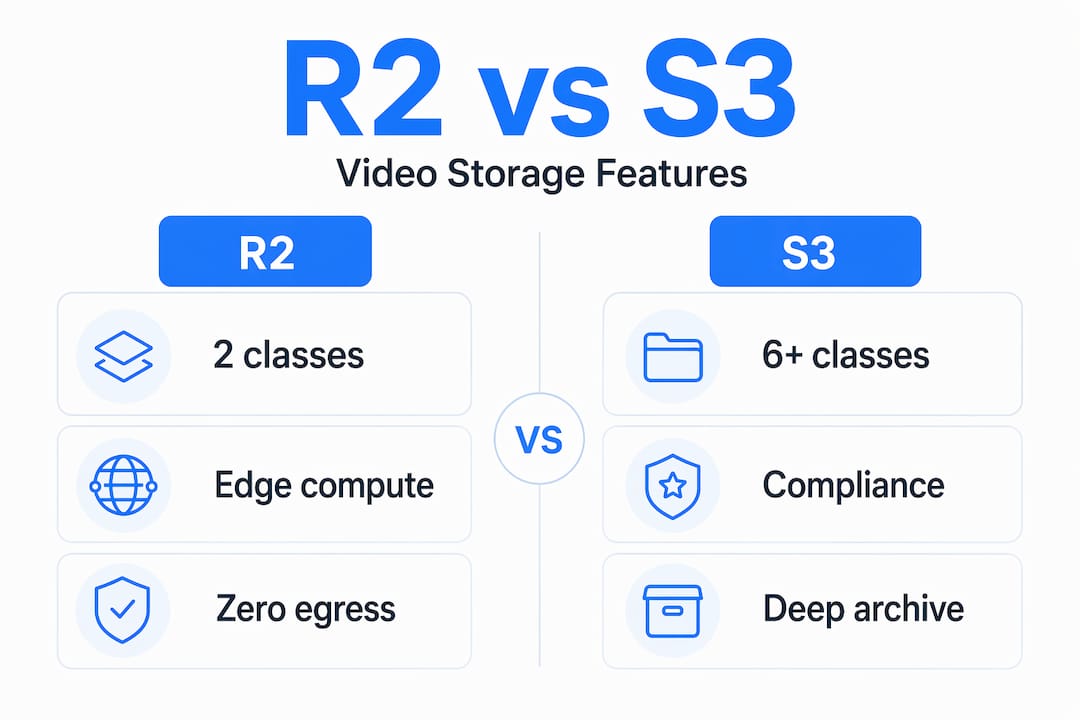
The feature gap extends beyond storage tiers. S3 lacks several R2 equivalents in reverse too. R2's native integration with Cloudflare Workers is genuinely powerful for video workflows. You can run edge logic directly at Cloudflare's network, transforming or routing video requests without incurring egress costs. For adaptive streaming or dynamic thumbnail generation at the edge, that combination is difficult to replicate on S3 without significant additional infrastructure.
Where S3 leads clearly is compliance. S3 holds certifications across HIPAA, FedRAMP, and PCI DSS. If you're handling regulated video content, medical recordings, government media, or financial compliance archives, R2 cannot meet those requirements today. That's not a minor footnote. It's a hard constraint.
Pro Tip: If your video archive needs to satisfy a compliance audit, start with S3. No amount of egress savings is worth building on a platform that fails your legal requirements. For everything else, evaluate whether you actually use advanced features like Object Lock before treating them as must-haves.
Performance and technical considerations
From a technical integration standpoint, the R2 vs S3 comparison is more favorable to R2 than most people expect. Migrating from S3 to R2 typically requires only a configuration update: swap the endpoint URL and credentials, and most S3 SDKs and CLI tools like rclone work without code changes. That means the switching cost is low if you're currently on S3 and want to test R2 for your delivery layer.

Latency tells a more complex story. R2 performance for cold reads is generally competitive, but S3 benefits from decades of optimization inside the AWS network and has well-documented performance at extreme scale. For video platforms where every 100ms of buffer time affects watch rates, that distinction matters. The Cloudflare network's global footprint does offset some of this for R2, particularly when paired with Workers at the edge.
On the AWS side, the ecosystem depth is a legitimate advantage:
- Lambda triggers fire on object events, enabling automated video transcoding or metadata extraction when a file lands in S3
- S3 Select lets you query structured data inside objects without downloading the full file, useful for video metadata and subtitle files
- CloudFront integration makes S3-to-CloudFront transfer free, reducing effective egress costs to $0.02 to $0.06/GB depending on region
- AWS Elemental MediaConvert connects directly into S3, making S3 the natural storage layer for AWS-native video processing pipelines
R2's edge advantage through Cloudflare Workers integration allows compute to happen at the network edge without egress costs. For use cases like live stream origin failover, real-time request routing, or per-user video access control, Workers plus R2 can replace several moving parts in a typical AWS stack.
Pro Tip: If your video infrastructure already relies on AWS services like Elemental, Rekognition, or Lambda for video processing, the integration cost of moving to R2 for delivery may outweigh the egress savings. Audit your actual AWS service dependencies before migrating.
When to choose R2 vs S3 for video
The video storage comparison between R2 and S3 comes down to your traffic pattern, compliance requirements, and existing infrastructure. Here's a practical framework:
-
Choose R2 if you're serving large video files to the public at high volume. The zero egress model makes cost predictable. A platform delivering 50TB per month saves approximately $4,500 compared to S3 Standard egress, and that number scales linearly. The multi-cloud storage approach works well here, using R2 for the delivery layer.
-
Choose S3 if compliance is a requirement. HIPAA, FedRAMP, and PCI DSS certified workflows have no current equivalent on R2. There is no workaround for this.
-
Choose S3 if you need deep archival storage. Raw footage, production archives, and long-term retention at scale become significantly cheaper in Glacier Deep Archive. At 15x the price difference, R2 loses badly for cold storage.
-
Consider a hybrid architecture for mature video platforms. Hybrid workflows combining R2 and S3 are increasingly common. Store originals and cold archives in S3 Glacier, serve processed video through R2 with Workers at the edge. This approach captures egress savings on delivery while retaining S3's archival economics and compliance coverage.
-
Model your API call volume before switching. High-frequency streaming applications that generate tens of millions of requests per day need to calculate R2's operation costs against the egress savings. The operational costs on R2 are real and scale with request frequency.
The choice between R2 and S3 depends largely on your traffic profile. R2 excels at bandwidth-heavy public delivery while S3 suits enterprise, compliance, and deep integration needs. Neither platform is universally better. The best answer depends on what you're actually building.
My honest take after watching teams make this choice
I've watched engineers get excited about R2's zero egress number and rush to migrate, only to realize three months later that their AWS Lambda video processing pipeline breaks apart without S3 as the trigger source. The egress savings are real and they're significant at scale. But the AWS ecosystem is sticky in ways that are easy to underestimate until you're deep in the migration.
What I've found actually works is treating these two storage solutions as complements rather than competitors. The teams I've seen get the most value from R2 are the ones who moved their public delivery layer to R2 first, kept their processing and archival workflows on S3, and verified the savings before making broader changes. That phased approach avoids the trap of discovering hidden dependencies after you've committed.
The other thing I'd flag: R2's operation costs are buried in the pricing page in a way that trips up cost models. Zero egress is the headline. But if you're running a transcription SaaS or an AI training pipeline that generates constant read requests against large video datasets, those Class B reads at $0.36 per million will show up on your bill in ways your initial estimate didn't account for. Model the full cost, not just the headline number.
The hybrid strategy is not a compromise. For most video platforms above a certain scale, it's the right answer. R2 for serving, S3 for storing cold and compliant data. The two services doing what each does best.
— Alexandre
Scale your video extraction with Tornadoapi
When your storage decision is made, the next question is where the video files actually come from. Tornadoapi sits between YouTube, Instagram, TikTok, Spotify and your storage layer. One API call ships the file directly to your R2 bucket, your S3 prefix, GCS, or Azure container. No proxy management, no anti-bot headaches, no format normalization work. Tornadoapi delivers 300TB per month at 99.998% extraction reliability with direct cloud delivery built in. If your team is building video extraction pipelines at scale, explore the production pricing tiers and see where Tornadoapi fits in your stack. A 30-minute infrastructure call is available at cal.com/velys/30min.
FAQ
What is the main cost difference between R2 and S3 for video?
R2 charges zero egress fees while S3 charges $0.09/GB after 100GB per month, saving approximately $900/month per 10TB of video served. R2 storage also costs about 35% less per GB than S3 Standard.
Can I migrate from S3 to R2 without rewriting my code?
Yes. R2 is S3-compatible, so most S3 SDKs, CLI tools, and rclone work after swapping the endpoint URL and credentials. Migration is typically a configuration change, not a code rewrite.
Does R2 support compliance requirements like HIPAA or FedRAMP?
No. S3 holds certifications for HIPAA, FedRAMP, and PCI DSS. R2 does not currently offer equivalent compliance coverage, making S3 the required choice for regulated video workloads.
Is a hybrid R2 and S3 setup practical for video platforms?
Yes, and it's increasingly common. Using R2 for public delivery and S3 for cold archival and compliance combines the egress savings of R2 with the deep storage economics and feature depth of S3.
Do R2 API operation costs offset the egress savings for video streaming?
They can at very high request volumes. R2 charges $4.50 per million Class A operations and $0.36 per million Class B reads. Model your actual request volume against your egress volume to verify net savings before migrating.