
Cloud Delivery in Video Pipelines: A 2026 Guide
Cloud delivery in video pipelines is defined as the end-to-end use of cloud infrastructure to ingest, process, store, and distribute video content at scale, replacing fixed broadcast hardware with software-defined, pay-as-you-go systems. The CDN market sits at $26.47 billion in early 2026 and is projected to reach $45.13 billion by 2030, which tells you exactly how fast production teams are moving workloads off-premises. For video production professionals and content creators, understanding the role of cloud delivery in video pipelines is no longer optional. It determines whether your workflow scales to a global audience or collapses under load.
What is the role of cloud delivery in video pipelines?
Cloud delivery replaces every fixed physical component in a traditional broadcast chain with virtualized, software-defined resources that spin up on demand and shut down when the job is done. The practical result is rapid deployment, global distribution, and a cost model that matches your actual output rather than your peak capacity.
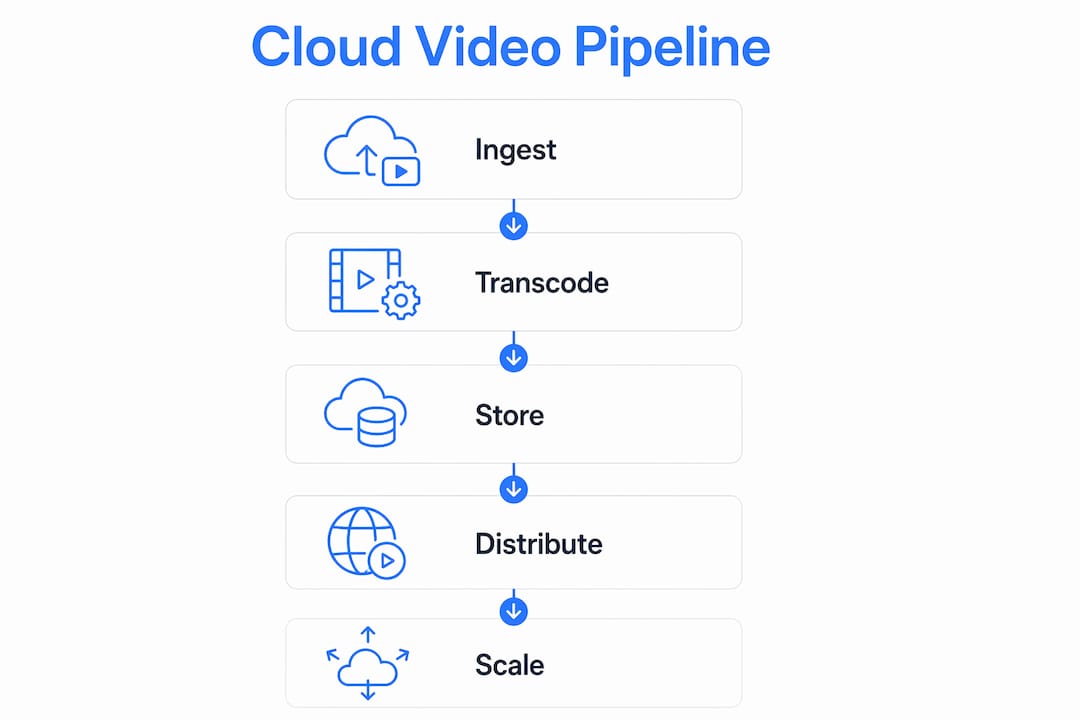
A modern video pipeline architecture built on cloud delivery moves through four distinct stages. Ingest pulls raw video from cameras, encoders, or platform sources using protocols like SRT, RTMP, or direct API extraction. Transcoding converts that raw input into multiple bitrate renditions for adaptive bitrate (ABR) delivery. Cloud storage holds both the working files and the long-term archive. A content delivery network (CDN) then pushes the final output to viewers at the edge.

Each stage runs independently and scales independently. That separation is what makes cloud-native pipelines fundamentally different from on-premises broadcast chains, where a single hardware failure can take down the entire workflow.
Pro Tip: If you are evaluating cloud delivery for the first time, read Tornadoapi's overview of direct cloud delivery before specifying any infrastructure. It covers the 2026 protocol landscape in practical terms.
What are the key components of a cloud video pipeline?
Every production-grade cloud video pipeline shares the same core components, even if the vendors differ. Understanding what each layer does, and what it costs when misconfigured, saves significant engineering time.
| Component | Function | Key Consideration |
|---|---|---|
| Ingest layer | Receives live or file-based video via SRT, RTMP, or API | Redundant ingest endpoints prevent single points of failure |
| Cloud transcoder | Generates ABR ladder renditions (H.264, H.265, AV1) | GPU/FPGA accelerators cut encoding time and cost |
| Cloud storage | Stores mezzanine files, renditions, and archives | Lifecycle policies move cold assets to cheaper tiers automatically |
| CDN | Delivers content to end users at the edge | Multi-CDN setups provide failover and performance routing |
| Monitoring layer | Tracks pipeline health and viewer quality in real time | MaaS tools catch degradation before it reaches the audience |
Transcoding and ABR ladder generation
Cloud transcoding is where most of the compute cost lives. A single live event can require simultaneous encoding into six or more renditions, from 240p mobile to 4K HDR. Intelligent transcoding yields up to 50% bandwidth savings by encoding only the complexity each scene requires, rather than applying a fixed bitrate across the entire stream. That saving compounds across millions of views.
Cloud storage tiers and lifecycle policies
Cloud storage for video is not a single product. AWS S3, Cloudflare R2, and Google Cloud Storage each offer hot, infrequent access, and archival tiers. The cost difference between hot and archival storage is dramatic. One documented case shows organizations reducing annual storage costs from $1.7 million to $347,000 by moving 5,600 TB to cloud archival tiers. Lifecycle policies automate the transition, so your team does not manage it manually. For a detailed comparison of R2 versus S3 for video workflows, Tornadoapi's breakdown of R2 vs S3 storage covers the egress fee implications directly.
CDN architecture and multi-CDN delivery
Multi-CDN strategies are now standard practice. 59% of enterprises use more than one CDN provider, and edge CDN nodes now exceed 12,000 globally, improving delivery speeds by 42% compared to single-CDN configurations. The logic is straightforward: if one provider has a regional outage, traffic routes automatically to the next. For live sports or large-scale events, that failover capability is non-negotiable.
How does cloud delivery improve reliability and scalability?
The core reliability argument for cloud-based video distribution is elasticity. On-premises infrastructure is sized for peak load and sits idle the rest of the time. Cloud resources scale to match actual demand, which means a 10x traffic spike during a live event does not require you to own 10x the hardware year-round.
Cloud-native pipelines reduce total cost of ownership by up to 80% when archival storage is factored in. That figure reflects both the hardware savings and the reduction in facilities, power, and maintenance costs. For independent creators and mid-size production companies, that shift from capital expenditure to operational expenditure changes what is financially viable.
Latency is the other major reliability metric. End-to-end latency under one second is achievable for live sports using cloud pipelines with regional edge caching. That is broadcast-grade performance delivered without a satellite truck. Regional edge caching places content copies close to viewer populations, so the delivery path shortens and buffering drops.
"MaaS enables proactive issue mitigation before global audience impact." — Google Cloud Media CDN
Monitoring as a Service (MaaS) gives cloud engineers real-time visibility into every stage of the pipeline, from ingest health to CDN hit rates to viewer rebuffering ratios. Without MaaS, you find out about a degraded stream when viewers complain. With it, you catch the problem before it reaches the audience.
Pro Tip: Set MaaS alerts on three metrics before any live event: ingest bitrate variance, CDN cache hit ratio, and viewer rebuffering rate. Those three numbers tell you where a failure is occurring before it becomes visible to your audience.
Key reliability benefits of cloud delivery include:
- Dynamic scaling handles traffic spikes without pre-provisioned hardware
- Event-triggered cloud recording reduces storage consumption by 60 to 80% compared to continuous recording
- Geographic redundancy across multiple availability zones eliminates single-region failures
- Automated failover in multi-CDN setups maintains uptime during provider outages
- Pay-per-use pricing removes the cost penalty for idle capacity between productions
What are the best practices for integrating cloud delivery with existing architecture?
The most common mistake video teams make when adopting cloud delivery is treating it as a rip-and-replace project. It is not. The better approach extends your existing infrastructure rather than discarding it.
-
Audit your current pipeline first. Map every component from camera to viewer. Identify which stages are compute-bound (transcoding), which are latency-sensitive (ingest switching), and which are purely storage-driven (archiving). That audit tells you where cloud delivery adds the most value immediately.
-
Keep high-performance ingest and switching on-premises or in private VPCs. Hybrid cloud pipelines preserve workflow investments by keeping the low-latency, high-throughput work close to the source and offloading burst transcoding and CDN delivery to the public cloud. Telestream Vantage Cloud is one example of a platform built explicitly for this hybrid model.
-
Place cloud components in the same availability zone. Same-AZ placement for NDI mixers, transcoders, and storage minimizes inter-component latency and eliminates the data transfer fees that accumulate when traffic crosses AZ boundaries. On AWS, cross-AZ data transfer costs add up faster than most teams expect.
-
Implement storage lifecycle policies from day one. Edge caching and storage tiering are the two most effective tools for controlling egress costs. Hot storage for active projects, infrequent access for recent archives, and Glacier-equivalent tiers for long-term retention. Tornadoapi's guide on zero egress fees explains how to structure these policies to avoid surprise billing.
-
Validate at 10% of production load before full rollout. Run your new cloud components in parallel with your existing pipeline at reduced scale. Measure latency, error rates, and cost per hour. Only cut over when the numbers match your targets.
Pro Tip: Size your cloud transcoding instances based on measured encode time, not theoretical throughput. Vendors publish peak numbers. Your actual workload, with its mix of scene complexity and codec settings, will perform differently. Always benchmark with real content before committing to an instance type.
Which cloud delivery technologies are shaping video pipelines in 2026?
The most significant shift in cloud video processing in 2026 is the integration of AI directly into the pipeline, not as a post-production tool but as a real-time processing layer.
AI video search platforms now index billions of frame embeddings and achieve sub-10ms retrieval speeds for video queries at production scale. Platforms like Zilliz Cloud use vector compression and tiered storage to reduce storage costs by 10x compared to raw frame storage. For content creators building searchable video libraries or AI labs constructing training datasets, this changes the economics of video intelligence entirely.
| Capability | Traditional pipeline | Cloud-native pipeline |
|---|---|---|
| Transcoding | Fixed hardware encoders | GPU/FPGA cloud instances, auto-scaled |
| Storage | On-prem NAS/SAN | Tiered cloud storage with lifecycle policies |
| Delivery | Single CDN | Multi-CDN with intelligent traffic routing |
| Monitoring | Manual QC checks | MaaS with real-time alerting |
| Video search | Manual tagging | AI vector embedding with sub-10ms retrieval |
| Latency | Seconds to minutes | Under 1 second achievable for live streams |
Low-latency protocols are also maturing. WebRTC, originally built for browser-to-browser communication, now powers interactive streaming at scale, enabling sub-500ms delivery for use cases like live auctions, sports betting, and real-time audience participation. Edge computing extends this further by running personalization logic and dynamic ad insertion at CDN nodes rather than at origin, which cuts the round-trip time for personalized content delivery to near zero.
GPU and FPGA-accelerated transcoding is now accessible at cloud scale through AWS Elemental MediaConvert, Google Cloud Transcoder API, and similar services. These accelerators reduce encode time for a 4K HDR file from hours to minutes, which matters enormously for time-sensitive news and sports content.
Key takeaways
Cloud delivery in video pipelines works because it separates ingest, transcoding, storage, and distribution into independently scalable layers, each optimized for cost and performance.
| Point | Details |
|---|---|
| Cloud delivery is a layered architecture | Ingest, transcoding, storage, and CDN each scale independently for maximum efficiency. |
| Multi-CDN is the reliability standard | 59% of enterprises use multi-CDN to achieve failover, performance routing, and cost control. |
| Hybrid beats rip-and-replace | Keep latency-sensitive ingest on-premises and offload burst transcoding and delivery to the cloud. |
| Storage tiering cuts costs dramatically | Lifecycle policies moving assets from hot to archival storage can reduce annual costs by 80%. |
| AI is now a pipeline component | Vector embedding databases enable sub-10ms video search at production scale in 2026. |
What I've learned optimizing cloud video pipelines
The teams that get the most out of cloud delivery are not the ones with the biggest budgets. They are the ones who treat the pipeline as a product, not a project. They instrument everything, they set cost alerts before they set performance targets, and they never assume that a vendor's published SLA reflects what they will actually experience at 3am during a live event.
The hybrid model is underrated. I have seen teams spend months migrating ingest infrastructure to the cloud only to discover that the latency introduced by routing live feeds through a public cloud region degraded their switching quality. Keeping ingest and live switching in a private VPC or on-premises, and using the cloud for transcoding and delivery, is almost always the right call for production-grade workflows.
Cost surprises in cloud video almost always come from two places: data egress and unmanaged storage growth. Both are preventable. Egress fees accumulate when you have not thought carefully about where your components sit relative to each other. Storage grows because nobody set a lifecycle policy on the ingest bucket. Fix those two things first and the rest of the cost model becomes predictable.
The AI integration trend is real and it is moving fast. Vector embedding databases for video search are not a future capability. They are in production today at frontier AI labs and transcription SaaS platforms. If you are building a video pipeline in 2026 and you are not thinking about how your content will be indexed and retrieved by AI systems, you are already behind. Start with a small-scale test on your existing archive before committing to a full implementation.
— Alexandre
Scale your video pipeline with Tornadoapi
Tornadoapi is the extraction and cloud delivery layer that sits between YouTube, Spotify, Instagram, TikTok, and your pipeline. One API call handles anti-bot systems, proxy rotation, format normalization, and direct delivery to S3, R2, GCS, or Azure. The infrastructure delivers 300 TB per month at 99.998% extraction reliability with 50 Gbps capacity. AI labs, transcription SaaS platforms, and podcast networks use Tornadoapi because it ships a contractual SLA on reliability, not a toolbox to manage. If your team is building or scaling a video ingestion pipeline, explore Tornadoapi's production tiers or book a 30-minute infra-to-infra call at Cal.com/velys/30min.
FAQ
What is cloud delivery in a video pipeline?
Cloud delivery in a video pipeline is the use of cloud infrastructure to ingest, transcode, store, and distribute video content through software-defined, scalable services rather than fixed broadcast hardware. It enables pay-as-you-go scaling from a single viewer to hundreds of millions.
How does cloud delivery reduce video pipeline costs?
Cloud-native pipelines reduce total cost of ownership by up to 80% through archival storage tiering, elastic compute that eliminates idle hardware, and multi-CDN routing that optimizes delivery costs per gigabyte.
What is a multi-CDN strategy and why does it matter?
A multi-CDN strategy distributes video traffic across multiple CDN providers for failover and performance routing. 59% of enterprises use multi-CDN, and global edge nodes now exceed 12,000, improving delivery speeds by 42% over single-CDN configurations.
Should I replace my on-premises infrastructure with cloud delivery?
No. Hybrid cloud pipelines that keep latency-sensitive ingest and switching on-premises while offloading burst transcoding and CDN delivery to the cloud consistently outperform full cloud migrations for production-grade video workflows.
How does AI fit into a cloud video pipeline in 2026?
AI vector embedding databases now index billions of video frames and return search results in under 10ms at production scale. This capability is active today at AI labs and transcription platforms building large video datasets.