
Video Content Understanding: A 2026 Guide for Creators
Video content understanding is the automated process of interpreting what happens inside a video by analyzing visual frames, audio signals, and textual data to generate structured, queryable metadata. The industry term for this discipline is semantic video understanding, and it sits at the intersection of computer vision, natural language processing, and multimodal AI. For content creators, marketers, and technologists, mastering what is video content understanding means unlocking the ability to search, tag, and extract insights from video at a scale no human team can match.
What is video content understanding, exactly?
Video content understanding is an end-to-end pipeline that transforms raw pixels into structured outputs such as event logs, searchable transcripts, and semantic labels. It moves well beyond simple object detection. The system simultaneously analyzes audio, visual, and textual streams to interpret narrative, context, and meaning across time.
Three core technologies power this process. Convolutional Neural Networks (CNNs) extract spatial features from individual frames. Vision Transformers (ViTs) capture long-range dependencies across frame sequences. Large Language Models (LLMs) then reason over the combined outputs to produce human-readable, structured data. The result is a video that a machine can not only watch but genuinely describe.

This distinction matters for your workflow. A video that a machine understands becomes a searchable asset. A video that a machine merely stores is a liability sitting in a folder.
How does video content understanding work technically?
The technical workflow follows three stages: preprocessing, feature extraction, and multimodal reasoning. Each stage feeds the next, and skipping any one of them degrades the quality of the final output.
Stage 1: Preprocessing
The pipeline begins by splitting the video into its component streams. Audio gets transcribed using tools like OpenAI Whisper. Frames get extracted at defined intervals, typically 1–4 frames per second depending on the use case. Subtitles or embedded captions are parsed as a separate textual stream. This stage produces the raw ingredients for analysis.
Stage 2: Feature Extraction
CNNs and ViTs process each frame to identify objects, scenes, faces, and actions. Whisper or similar speech recognition models convert audio into timestamped transcripts. Named entity recognition models scan the text for brands, people, and locations. Each modality produces its own feature vector, a numerical representation of what it detected.
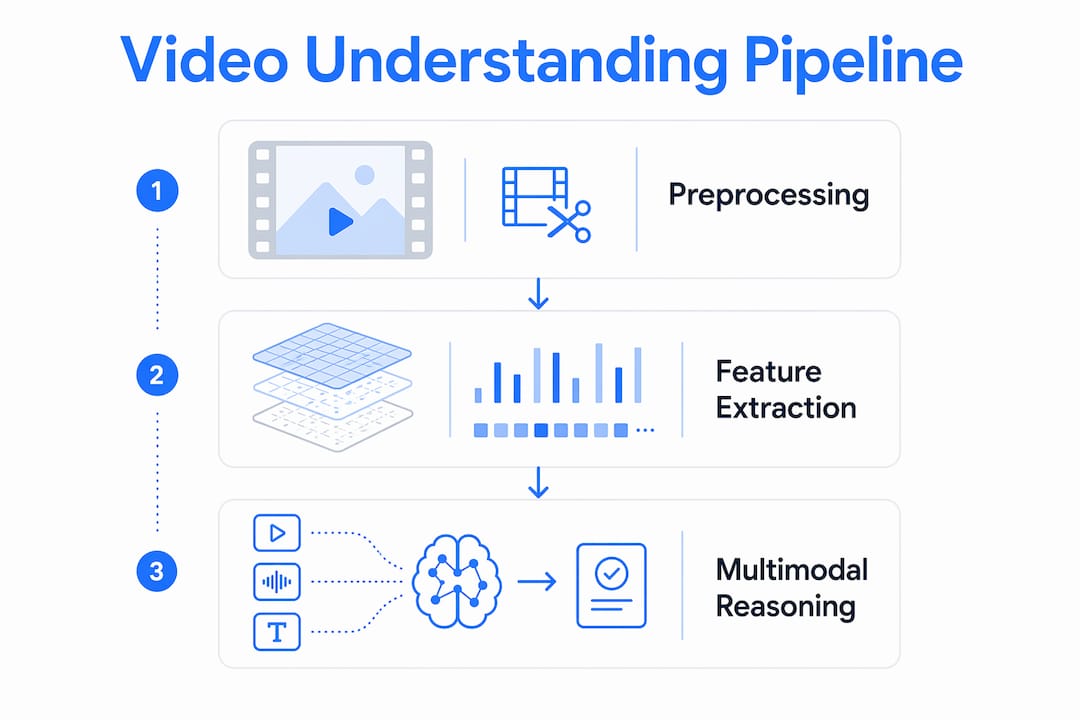
Stage 3: Multimodal Reasoning
An LLM or multimodal model fuses all three feature streams into a single coherent representation. Multimodal fusion correlates audio transcripts, visual detections, and textual metadata to map videos into vector databases. This step resolves ambiguities that pure visual analysis cannot. A scene showing two people arguing looks different when the audio transcript reveals they are lawyers debating a contract.
The final output arrives as structured JSON, API responses, or webhooks that your application can query directly.
Pro Tip: When designing your pipeline, extract audio transcripts first. Transcripts are the cheapest modality to process and often resolve 60–70% of scene ambiguity before the visual models even run.
What are the main use cases for video analysis?
The practical applications of video content interpretation span every industry that produces or consumes video at scale.
- Automated content tagging. Media libraries at companies like Getty Images and streaming platforms use AI to tag thousands of hours of footage with scene descriptions, emotions, and objects without human review. This replaces weeks of manual logging with minutes of processing.
- Marketing sentiment and brand exposure analysis. Marketers track how often a brand logo appears on screen, in what context, and alongside what sentiment signals. This turns sponsorship deals and influencer campaigns into measurable data.
- Real-time security monitoring. AI systems process hundreds of concurrent video streams simultaneously, something no human security team can replicate. Anomaly detection flags unusual behavior the moment it appears.
- Enterprise video search with RAG. Retrieval-Augmented Generation (RAG) systems index video transcripts and metadata into vector databases. Employees at companies like Salesforce or Microsoft can then ask natural language questions and receive timestamped video clips as answers.
- Highlight generation for content creators. Platforms like YouTube and podcast tools automatically detect applause, laughter, or high-energy moments to generate short-form clips from long recordings.
Each of these use cases replaces a manual review workflow with a structured, repeatable process. The importance of video comprehension at scale is not theoretical. It is the difference between a content library that earns revenue and one that collects dust.
Video analytics vs. AI video analysis: what is the difference?
These three terms get used interchangeably, but they describe fundamentally different capabilities. Choosing the wrong tool for your use case wastes both time and budget.
| Capability | Traditional Video Analytics | AI Video Analysis | Video Content Understanding |
|---|---|---|---|
| Core method | Rule-based motion detection | Deep learning, CNNs | Multimodal AI pipeline |
| Output | Alerts, counts, timestamps | Object labels, action tags | Structured semantic metadata |
| Temporal reasoning | None | Limited | Full sequence analysis |
| Multimodal input | Video only | Video only | Video, audio, and text |
| Best for | Security triggers | Classification tasks | Search, marketing, RAG |
Traditional video analytics uses rule-based motion detection and pixel-difference algorithms. It answers questions like "did something move?" AI video analysis uses deep learning architectures, specifically CNNs and Transformers, to classify objects and recognize actions. Video content understanding goes further still. It integrates detection, temporal reasoning, and multimodal inference into a single pipeline that answers questions like "what story does this video tell?"
The practical implication is direct. If you need a tripwire alarm, traditional analytics works. If you need to know whether a 45-minute product demo contains a competitor mention at the 23-minute mark, you need semantic video understanding.
What are the key challenges in deploying these systems?
Deploying video understanding in production is not plug-and-play. Pipeline design requires deliberate trade-offs between latency, cost, accuracy, and privacy. A pipeline optimized for real-time security monitoring looks nothing like one built for overnight batch processing of a media archive.
Abstract concept recognition remains the hardest open problem in the field. Recognizing concepts like justice, loyalty, or tension requires understanding how a narrative unfolds across minutes or hours, not just what appears in a single frame. Current foundation models handle concrete objects well but struggle with thematic inference. Hybrid systems that combine visual models with LLM-based narrative reasoning are the most promising direction.
Long-form video creates a separate class of problems. Processing a two-hour film linearly causes models to lose context and produce inaccurate summaries. Microsoft Research's Deep Video Discovery addresses this with an agentic loop approach: the system observes, analyzes, and plans which frames to inspect next rather than processing everything sequentially. This selective inspection preserves answer quality without exploding compute costs.
Custom schema design is another underestimated challenge. Generic AI outputs use generic vocabulary. A sports media company needs tags like "fast break" and "red zone," not just "running" and "outdoor scene." Your pipeline must map AI detections to your business vocabulary through custom segmentation logic.
Pro Tip: Build your taxonomy before you build your pipeline. Define the 20–30 labels your business actually queries, then train or prompt your models against those specific categories. Generic outputs require expensive post-processing to become useful.
Key takeaways
Video content understanding transforms raw video into structured, queryable data by combining visual, audio, and textual analysis through a multimodal AI pipeline.
| Point | Details |
|---|---|
| Three-stage pipeline | Preprocessing, feature extraction, and multimodal reasoning each serve a distinct role. |
| Multimodal fusion is required | Audio, visual, and text streams must combine to resolve scene ambiguity accurately. |
| Not all video AI is equal | Traditional analytics, AI analysis, and semantic understanding solve different problems. |
| Abstract concepts remain hard | Thematic inference across long videos requires hybrid models, not single-frame classifiers. |
| Custom schemas matter | Generic AI outputs must map to business-specific vocabulary to deliver real value. |
Why most teams underestimate the complexity here
I have seen teams deploy a transcription model, call it "video understanding," and wonder why their search results are mediocre. Transcription is one modality. Real semantic understanding requires all three streams working together, and the fusion layer is where most implementations fail.
The teams that get this right share one habit: they define their output schema before they choose their models. They know exactly what structured data they need, and they work backward to the pipeline architecture. Teams that start with a model and hope the outputs are useful end up rebuilding from scratch six months later.
The evolution toward better abstract concept understanding is genuinely exciting. Foundation models from Google DeepMind and OpenAI are closing the gap between what a machine detects and what a human infers. But that gap is not closed yet. The practical advice I give every team is to build for what the technology reliably delivers today, and design your architecture so you can swap in better models as they arrive. Rigid pipelines become expensive technical debt fast.
For long-form content specifically, the agentic approach from Microsoft Research is the most important architectural shift happening right now. Linear processing of a 90-minute video is both expensive and inaccurate. Selective, goal-directed frame inspection is how production systems will work within two years. If you are building a video intelligence pipeline today, design for agentic retrieval from the start.
— Alexandre
Get your video data pipeline production-ready with Tornadoapi
Building a semantic video understanding system starts with reliable video extraction. If your pipeline cannot consistently pull clean video files from YouTube, TikTok, Instagram, or Spotify, the rest of your AI stack has nothing to work with.
Tornadoapi delivers bulk video extraction at production scale, handling anti-bot systems, proxy rotation, and format normalization so your team writes one API call and receives a clean file. With 300 TB delivered monthly and 99.998% extraction reliability, Tornadoapi removes the infrastructure bottleneck that stalls most video AI projects before they start. Teams building transcription SaaS, RAG pipelines, and training datasets use Tornadoapi because it ships with a contractual SLA, not a toolbox to manage. Explore production-scale plans built for teams that need reliability at volume.
FAQ
What is video content understanding in simple terms?
Video content understanding is the automated process of analyzing a video's visual frames, audio, and text to generate structured metadata like tags, transcripts, and event logs. It lets machines describe, search, and reason about video content the way a human analyst would.
How does video content understanding differ from video analytics?
Traditional video analytics uses rule-based detection to trigger alerts, while video content understanding uses multimodal AI to extract semantic meaning across an entire video. The distinction matters when you need search, summarization, or narrative-level insights rather than simple motion alerts.
What technologies power semantic video understanding?
The core technologies are CNNs and Vision Transformers for visual feature extraction, Whisper for audio transcription, and LLMs for multimodal reasoning and structured output generation. These components work together as a pipeline, not as standalone tools.
Why is multimodal fusion important for video comprehension?
Relying on visual data alone creates ambiguity that audio and text resolve. Correlating all three modalities produces context-aware representations that accurately distinguish between visually similar but semantically different scenes.
What is the biggest technical challenge in video understanding today?
Abstract concept recognition is the hardest unsolved problem. AI models handle concrete objects well but struggle to infer themes like tension or loyalty that unfold across time in long-form video. Hybrid systems combining visual models with LLM-based narrative reasoning are the current best approach.