
Top 6 decodo.com Video Extraction Alternatives 2026
Orchestrating high-volume video extraction for AI ingestion or data pipelines often means balancing reliability, speed, and integration with cloud storage. Many extraction APIs hide pricing, require lengthy sales calls for access to production features, or limit throughput with restrictive concurrency or incomplete anti-bot measures. This comparison breaks down pricing transparency, anti-bot capabilities, and cloud delivery support so you can match an extraction API to your operational and technical requirements without guesswork.
Table of Contents
- Tornado API
- HasData
- ZenRows
- ScrapingBee
- Scrapfly
- Scrapingdog
- Comparing Key Video Extraction API Providers
Tornado API
At a Glance
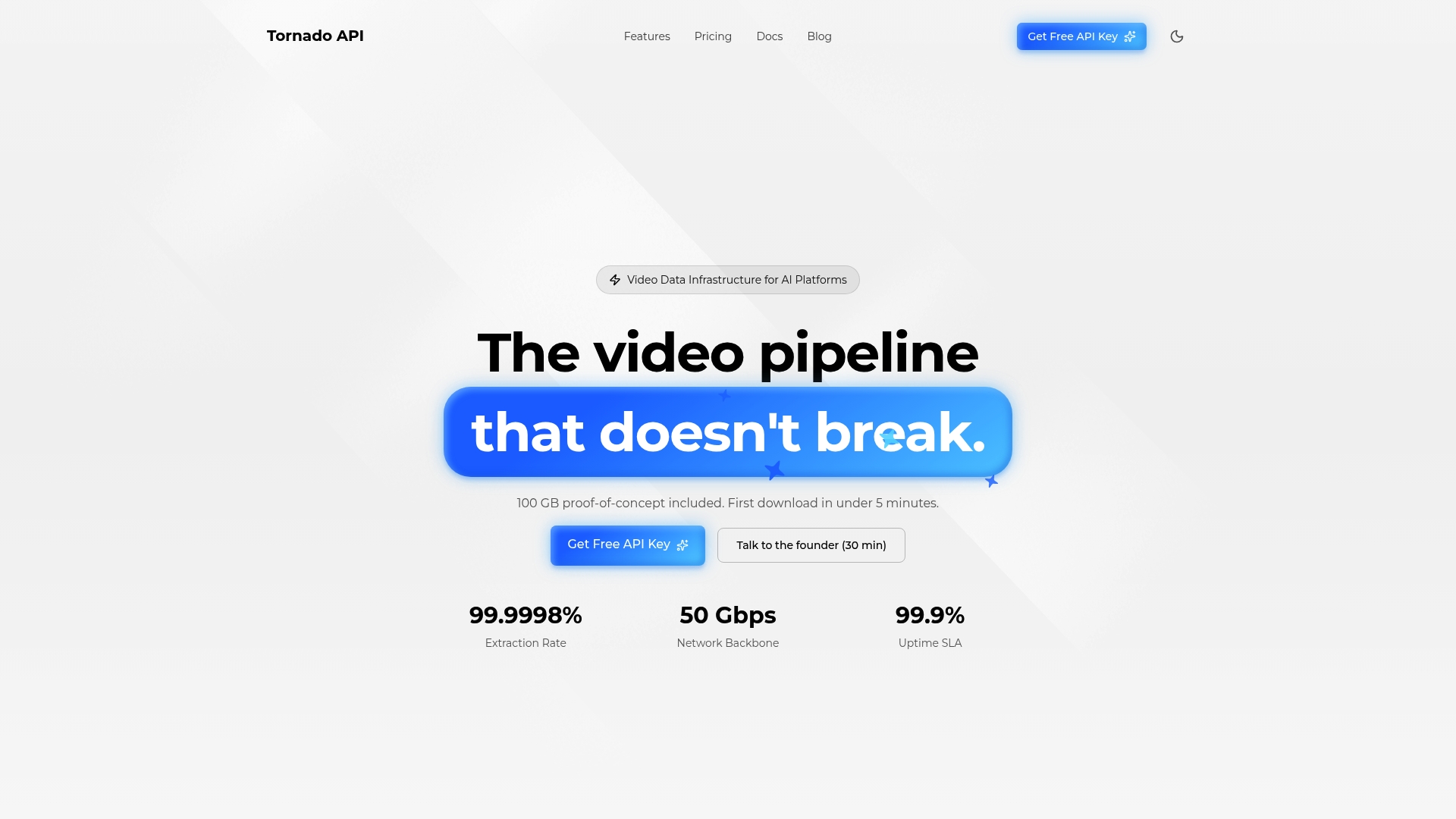
The vendor advertises a 99.9998% extraction success rate and a median job completion time of 7 seconds, plus direct cloud delivery with zero egress fees. Those claims position the service for high-volume AI ingestion where reliability and predictable costs matter.
Core Features
- Direct cloud delivery to AWS S3, Azure Blob, Google Cloud Storage, Alibaba OSS, and Cloudflare R2 with no egress fees.
- Proprietary anti-bot engine that the company says adapts to platform defenses within hours.
- Fast median job completion in 7 seconds with a 95th percentile under 1 minute for YouTube and Spotify content.
- Scalable throughput covering 100 GB up to 100 TB plus per month and SLA-backed reliability.
Key Differentiator
A defensive automation layer paired with cloud-native delivery. Tornado API combines a rapid-response anti-bot engine with direct-to-cloud upload so you avoid proxy maintenance and intermediate storage hops at scale. That pairing is the operational advantage for production pipelines.
Pros
-
High reliability claims backed by contractible SLAs, which helps operations teams write uptime requirements into procurement paperwork.
-
Eliminates double hops and egress surprises by delivering straight into your storage bucket, reducing transfer complexity and bookkeeping.
-
The speed and success figures above give predictable throughput for training pipelines that must consume terabytes on a schedule.
-
Adaptive anti-bot behavior reduces manual intervention after platform changes, cutting the time your infra team spends on extractor maintenance.
-
Flexible plans that span startup needs to enterprise volumes and support direct cloud targets across major providers.
Cons
- Pricing is not fully public and requires direct contact; that sales step can slow evaluation for smaller teams with tight procurement calendars.
Notable Integrations
AWS S3, Azure Blob Storage, Google Cloud Storage, Alibaba OSS, Cloudflare R2.
Who It's For
AI teams, media platforms, and research groups that ingest large media volumes and need predictable extraction at scale. If you operate training pipelines that pull terabytes per month, this product fits the operational profile.
Unique Value Proposition
Direct-to-cloud delivery with zero egress fees changes the arithmetic for bulk ingestion. For teams pulling 1 TB or more per month, eliminating intermediate downloads and egress billing reduces recurring costs and simplifies orchestration for model training or archival workflows.
Real World Use Case
A social media analytics firm automates bulk downloads of YouTube videos and Spotify podcasts for model training. They route files directly into GCS, rely on the adaptive anti-bot layer to avoid disruptions, and sustain high ingestion rates without manual extractor fixes.
Pricing
Starting from $1,200 per month for the Starter plan, which includes 1 TB of transfer. Enterprise pricing and high-volume plans are customized and require a sales conversation.
Website: https://tornadoapi.io
HasData
At a Glance
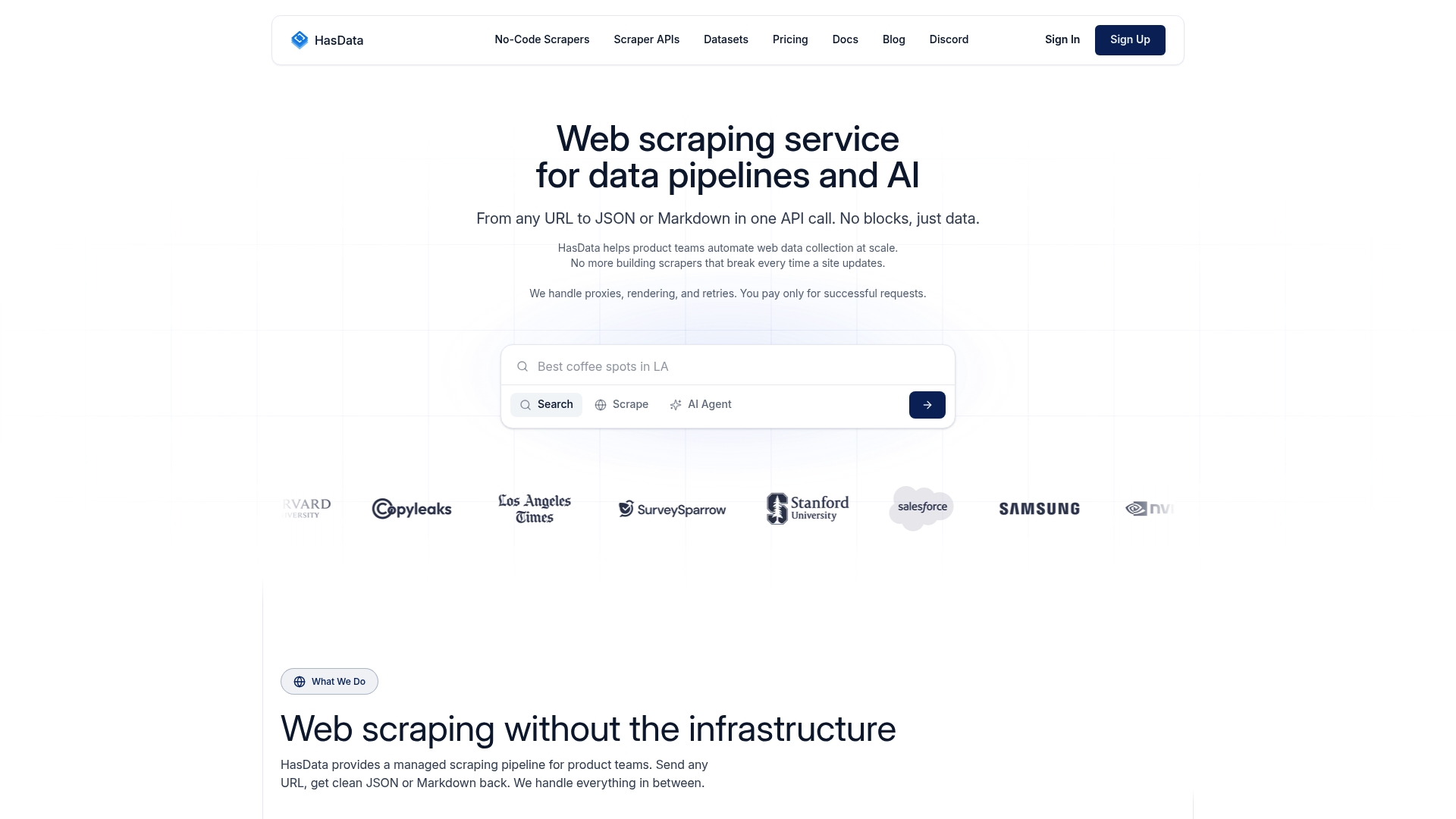
HasData's marketing materials state a suite of 40 API endpoints and 30 no-code scrapers, plus scale to millions of requests with 99.9% uptime and a 99.94% success rate. That pitch is aimed squarely at product teams that need production-grade scraping without building infrastructure.
Core Features
- Headless browser rendering for dynamic sites and single-page apps.
- Automatic proxy rotation with geo-targeting to avoid blocks and localize results.
- 70+ AI-powered extractors tuned for popular sources and common page patterns.
- Developer-friendly APIs with documented schemas and structured JSON output.
- Monitoring dashboards, retries, and anti-bot handling baked into the service.
Key Differentiator
HasData packages scraping infrastructure as a managed API so engineering teams skip building proxy pools, render farms, and extractor maintenance. That reduces operational drag for teams focused on data products rather than crawling ops.
Unlike TornadoAPI, which specialises in video extraction infrastructure and direct cloud delivery, HasData focuses on general web scraping for datasets and pipelines. The two address overlapping automation needs but serve different content types and workflows.
Pros
- Cloud API reduces setup time and lets teams move from prototype to production faster. Less infra overhead for engineers.
- The uptime and success figures above support predictable extraction windows, which matters for scheduled pipelines and retries.
- Structured JSON output simplifies ingestion into ML and analytics pipelines, cutting the transform step.
- Built-in JS rendering and anti-bot handling remove recurring maintenance for dynamic pages.
- Flexible, pay-as-you-go pricing and a free tier let teams validate volume before committing to larger plans.
Cons
- Complex or bespoke scraping targets often still require support work or custom extractor development from HasData.
- High-volume or high-complexity projects can escalate costs, especially if many render-heavy pages are required.
- The service expects technical teams; product managers without engineering support will face a steeper onboarding curve.
When It May Not Fit
If your team lacks developer resources, HasData's API-first model will slow adoption. Also avoid it for persistent scraping behind hard paywalls or deep authenticated workflows where legal or technical obstacles limit extraction.
Who It's For
Product teams, developers, and data engineers building large-scale, compliant web data pipelines. Ideal when you need reliable extraction at production scale and have engineering bandwidth to integrate and operate APIs.
Real World Use Case
An SEO SaaS firm automates daily SERP extraction using HasData's API. They moved rank checks from ad-hoc crawlers to scheduled jobs, reduced failed runs, and increased update frequency for clients without adding crawl infrastructure.
Pricing
Free tier available. Paid plans start at $49/month and scale up to $249/month with higher request limits and concurrency. Pay-as-you-go allows spikes without long-term commitments.
Website: https://hasdata.com
ZenRows
At a Glance
The vendor advertises advanced proxy rotation combined with browser emulation to bypass anti-bot measures and CAPTCHAs for scraping workflows. ZenRows targets developer teams running market research, price monitoring, or competitive analysis who need programmatic site extraction.
Core Features
- Proxy rotation and management to cycle IPs and reduce blocking during high-volume crawls.
- CAPTCHA solving mechanisms that attempt automated resolution when challenges appear on target pages.
- Browser emulation for data scraping so requests resemble real user behavior and execute client side scripts.
- IP whitelisting and access control for secure API access.
Key Differentiator
That proxy plus emulation combination is the product’s central claim and explains why teams pick ZenRows when conventional request libraries fail. Where Tornadoapi focuses on production delivery into ingestion pipelines with contractual SLAs and cloud sinks, ZenRows concentrates on developer‑level scraping techniques to get past anti-bot defenses.
Pros
- Helps bypass anti-scraping measures like CAPTCHAs and IP blocks, which shortens time spent fighting target site defenses.
- Supports proxy rotation for more reliable large scale extraction and to keep request volume distributed across IPs.
- Offers browser emulation so pages that rely on JavaScript render correctly before extraction.
- Designed for developers needing scalable web data collection and programmatic control over crawling logic.
- The vendor claims an extensive proxy infrastructure to maintain uptime and IP diversity, a practical advantage for sustained scraping jobs.
Cons
- The homepage gives limited detail on specific features and behavior, which makes evaluation slower for engineering teams.
- Potential technical complexity for users unfamiliar with web scraping APIs; setup and maintenance require engineering time.
- No clear pricing details available publicly, so budget planning requires outreach to sales or trialing the service.
When It May Not Fit
If your team lacks engineering resources to integrate and operate an API, ZenRows is a poor fit because it expects developer ownership of crawling logic and error handling. For teams that need guaranteed extraction delivery into cloud storage with an SLA, Tornadoapi’s infra focus is a better match.
If transparent, per‑unit pricing is a procurement requirement, ZenRows will frustrate you until sales provides a quote or a clear rate card.
Who It's For
Developers and data teams that build their own scraping pipelines and want tools to overcome bot defenses will get the most value. Research teams that can allocate engineering hours for integration and monitoring will see the fastest returns.
Real World Use Case
A retail analytics group automates price monitoring across competitor sites. They use ZenRows’ browser emulation to render product pages and proxy rotation to keep checks running hourly without triggering blocks. Alerts feed downstream dashboards for repricing decisions.
Pricing
ZenRows does not publish clear pricing on its public site. That means you will need to contact sales or sign up for an API trial to get tiering, rate limits, or volume discounts documented for budgeting.
Website: https://zenrows.com
ScrapingBee
At a Glance
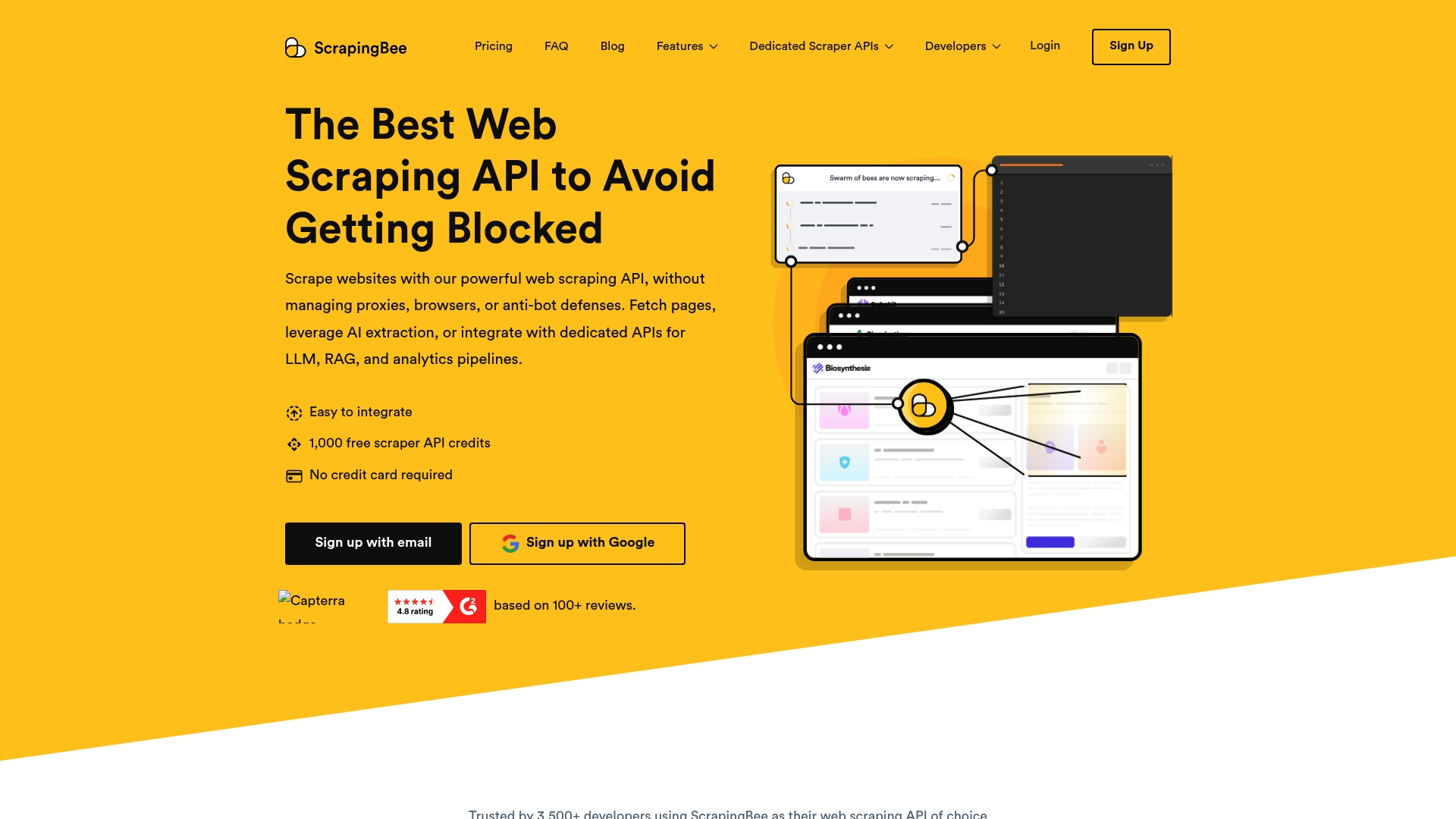
The vendor advertises 1,000 free scraper API credits on sign-up, which makes short experiments immediate and low risk. The company also states adherence to SOC 2 Type 2 and GDPR, a compliance posture many developer teams will ask about.
ScrapingBee targets teams that want an API-first extraction layer with built-in anti-bot handling and proxy rotation rather than a visual scraping tool.
Core Features
- JavaScript rendering in headless Chrome so pages that rely on client-side scripts return usable HTML.
- AI-ready extraction that outputs structured JSON or Markdown and supports natural language queries for downstream LLM workflows.
- Proxy rotation and stealth proxies automated by the API to reduce manual proxy management.
The API also includes a CLI for automation and vendor-provided endpoints aimed at common sources.
Key Differentiator
The vendor positions its product around combining AI-driven extraction with reliable JavaScript rendering and proxy management in one API call. That single-call approach reduces orchestration code for developers who feed data into models or pipelines.
Compared with TornadoAPI, which focuses on video extraction infrastructure and direct cloud delivery, ScrapingBee serves narrower web scraping and AI data ingestion needs for text and HTML sources.
Pros
- The vendor reports a large developer base and strong ratings, which suggests active community support and public examples to copy when you start a project.
- Built-in rendering plus proxy automation means fewer infra tasks. You can fetch a fully rendered page, parse it, and hand structured JSON to an LLM without standing up browsers or rotating proxies yourself.
- JSON output and Markdown options match tooling that expects LLM-ready records, speeding integration with model training and retrieval pipelines.
- The free credits and transparent tiering lower the barrier for prototyping before committing to monthly spend.
- The compliance claims above make ScrapingBee easier to evaluate for teams with governance checklists.
Cons
- Public-facing documentation and marketing leave some integration details vague, so you may need a proof of concept to validate edge cases.
- Pricing is credit-based, which the vendor structures around API credits. That model can become costly at high request volumes compared with flat-rate self-hosted solutions.
- The product focuses on traditional web sources. Support for nonstandard feeds or deeply customized crawling rules is not well documented.
When It May Not Fit
If your team needs a point-and-click visual scraper or an on-premise crawler, ScrapingBee’s API-first approach will feel cumbersome. It also may not be ideal for very small, infrequent scraping tasks where even low monthly minimums outweigh the convenience.
For large scale continuous scraping where per-request economics matter, evaluate the credit burn against alternatives or consider a negotiated enterprise plan.
Who It's For
Developers, data engineers, and product teams that need scalable web data extraction without managing browsers, proxies, or anti-bot logic. It fits projects where data flows directly into ML pipelines, search indexes, or monitoring systems.
Teams that need video, audio, or direct cloud delivery of large media files should look at specialist infra providers instead.
Real World Use Case
A retail analytics team uses ScrapingBee to poll competitor product pages, capture fully rendered descriptions and reviews, and produce structured JSON streams. An LLM-based pipeline then scores sentiment and flags anomalous price moves for the pricing ops team.
The prototype ran on the free credits and scaled to paid credits once the rule set stabilized.
Pricing
The vendor lists entry-level pricing starting at $49 per month for 250,000 API credits and scales to custom enterprise plans for high volume. Free credits on sign-up let you validate parsing before committing.
Website: https://scrapingbee.com
Scrapfly
At a Glance
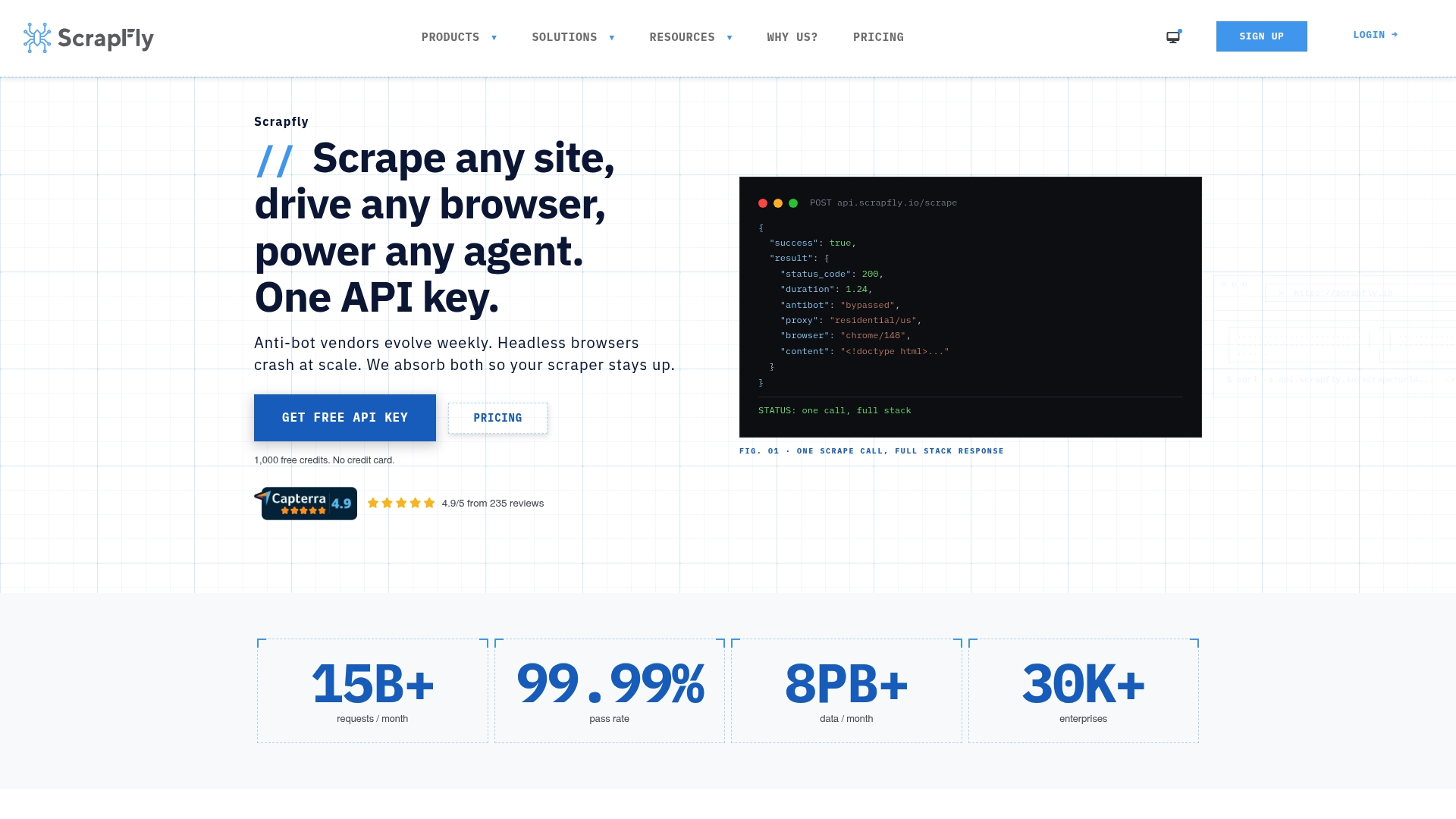
The vendor's marketing materials advertise a 98% success rate on heavily protected sites, a claim that frames Scrapfly as a reliability-first scraping option for engineering teams. That success claim pairs with failure refunds to reduce financial risk on failed requests.
Core Features
Scrapfly exposes a Single API that handles scraping, rendering, crawling, screenshots, and structured extraction so you do not juggle separate endpoints for common tasks.
The platform includes anti-bot support with advertised compatibility for 20+ vendors, a global proxy fleet that mixes residential and datacenter routes, and headless browser automation for JavaScript heavy pages.
Pretrained extraction models, CSS and XPath scraping, and LLM prompt hooks cover both rule based and model driven pipelines.
Key Differentiator
Scrapfly's defining angle is the one parameter anti-bot bypass and integrated proxy management that the vendor highlights. That approach shifts complexity into the platform so developers can focus on extraction logic rather than proxy orchestration.
Compared with Tornadoapi, which emphasizes direct cloud delivery and infra to infra reliability, Scrapfly skews toward developer controlled scraping and in platform anti bot tooling.
Pros
- High on defended sites. The success claim above gives you a clear buying signal when targets use aggressive bot defenses.
- Failure requests are free, which lowers cost exposure during tuning and reduces trial friction for large crawls.
- Unified tooling means fewer external moving parts: rendering, proxies, and extraction live under one API key so engineering work centers on data schemas.
- Compliance posture includes SOC 2 and ISO 27001 plus GDPR and HIPAA mentions, useful when you handle sensitive datasets or enterprise procurement.
- SDKs and no code connectors shorten integration time for data teams that want quick prototypes.
Cons
- There is a setup curve. Teams without scraping experience will spend engineering cycles on tuning fingerprints and render strategies.
- Costs scale with volume and with heavy rendering or proxy usage, so monthly bills can rise quickly for large continuous crawls.
- Pricing depends on request complexity, which complicates exact budgeting for unpredictable scraping patterns.
When It May Not Fit
If you need a turnkey, SLA backed extraction pipeline that pushes files directly into cloud buckets with contract level uptime guarantees, Scrapfly's developer centric model may force you to build additional infra.
Also avoid it if your team lacks scraping experience and you need hands off, managed dataset delivery for ML training.
Notable Integrations
Scrapfly lists connectors for Zapier, Make, and n8n for no code automations and developer oriented integrations with LlamaIndex, LangChain, and CrewAI for downstream ML pipelines.
Who It's For
Developers, data engineers, and teams building bespoke scraping or browser automation workflows who want control over proxies, rendering, and extraction logic. Enterprises that need compliance and SDK support will find the feature set familiar.
Real World Use Case
A data team uses Scrapfly to pull product prices from Amazon and eBay while routing around rate limits through the integrated proxy pool. They run browser rendering when product pages use heavy JavaScript and fall back to pretrained extractors for structured fields.
Pricing
Usage based pricing with free signup credits and plans starting at $30 per month. The vendor advertises custom enterprise contracts for high volume or bespoke requirements, and actual cost depends on rendering, proxy usage, and request complexity.
Website: https://scrapfly.io
Scrapingdog
At a Glance
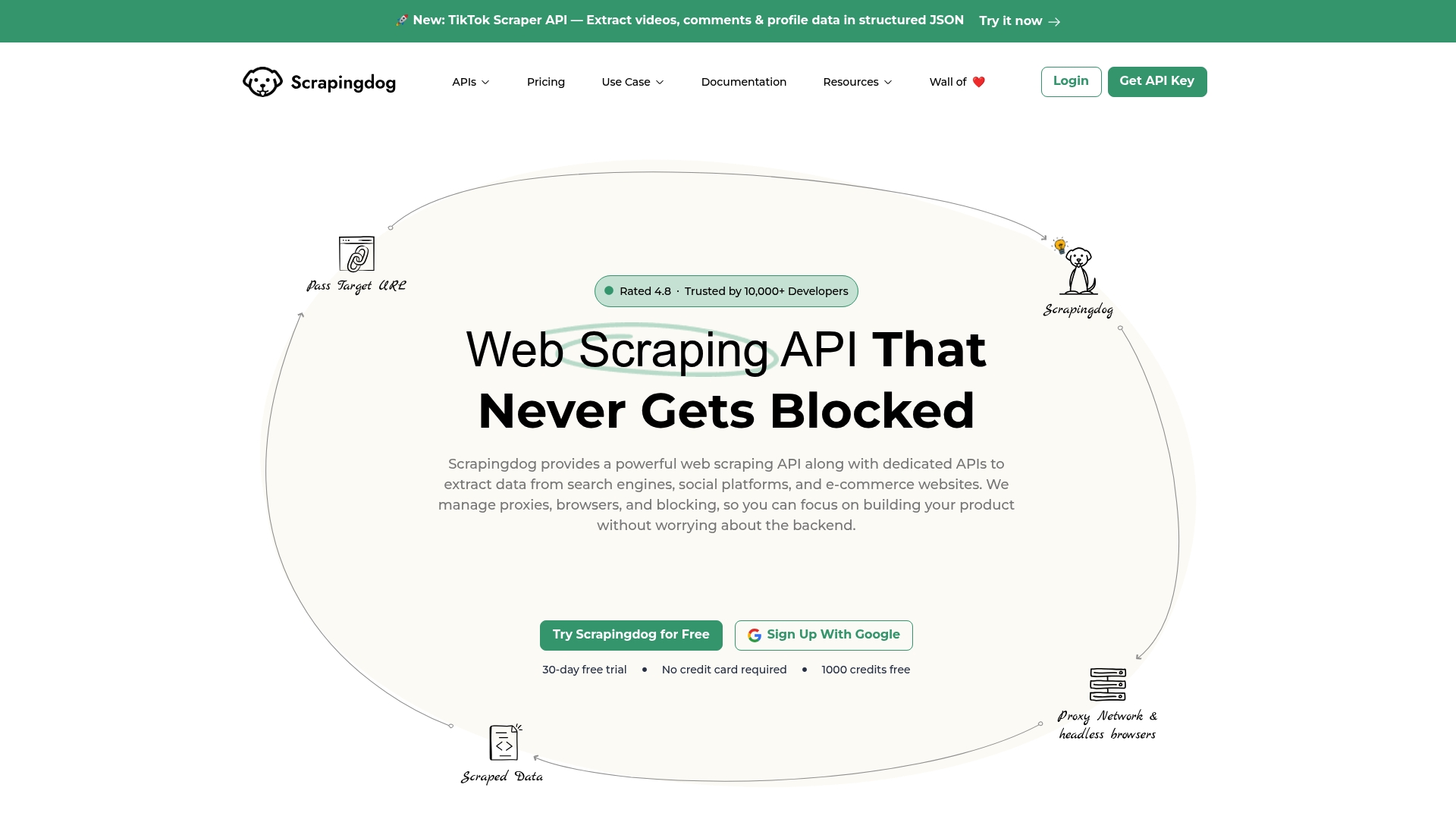
The vendor advertises rotating proxies across 40M+ IP addresses plus built-in CAPTCHA solving and headless rendering in a single API. That combination aims to remove proxy and anti-bot overhead for large scraping jobs without separate infrastructure.
Core Features
- Rotating proxies for high concurrency and geotargeting across many IPs.
- Headless Chrome rendering to fetch JavaScript-heavy pages and dynamic content.
- Automatic CAPTCHA solving to reduce manual intervention during crawls.
- Dedicated platform APIs for Google, Amazon, LinkedIn, and others that return structured JSON or Markdown for LLM inputs.
- High concurrency support designed for large-scale extraction and frequent polling.
Key Differentiator
Scrapingdog's marketing positions the stack around fully managed anti-bot and rendering capabilities plus platform-specific endpoints that deliver structured JSON with minimal parsing. That focus targets classic web scraping problems rather than the video extraction, SLA-backed cloud delivery, and direct cloud sinks that TornadoAPI emphasizes.
Pros
- Some users report a 100% success rate on tests, a claim you can use as a heuristic during evaluation. That feedback suggests reliability on common targets.
- The API handles proxies, CAPTCHAs, and headless rendering so your team can call one endpoint instead of maintaining multiple subsystems.
- Tiered pricing lets small projects start affordably and scale to larger plans as needs grow, which eases experimentation.
- Dedicated parsers for big platforms reduce the time you spend writing custom extraction rules and normalizing output for downstream systems.
- Geotargeting and concurrency settings support daily price checks or bulk dataset collection without manual IP rotation.
Cons
- Several user reports mention inconsistent customer support and occasional service issues, which raises operational risk for production pipelines.
- Cost can climb quickly at high volume; the platform may be expensive for continuous, global-scale scraping compared with in-house solutions.
- Large-volume setups require technical expertise to tune concurrency, rate limits, and parsing rules for stability.
When It May Not Fit
If you need a contractually backed SLA, dedicated account engineering, or guaranteed extraction reliability for video assets and cloud delivery, Scrapingdog is the wrong slice of the market. Also avoid it if your project requires the lowest possible per-request cost at extreme scale.
Who It's For
Developers, data analysts, and marketing teams that want a managed web scraping API to collect product listings, SERP data, or lead lists without running proxies and headless browsers themselves. Good for teams that can tolerate vendor support variability.
Real World Use Case
A retail team schedules daily price snapshots from a set of competitor stores. Scrapingdog returns normalized JSON for each SKU, the data feeds a pricing model, and the pipeline flags outlier price drops for manual review.
Pricing
Plans start at $33 per month for entry-level usage and scale to custom enterprise pricing for high-volume needs. The vendor advertises a 30-day free trial with no credit card required for initial evaluation.
Website: https://scrapingdog.com
Comparing Key Video Extraction API Providers
When evaluating video extraction and data ingestion APIs, features like operational reliability, compatibility with existing infrastructure, and flexibility in handling varied workloads become. To help identify the most suitable solution, here's a comparative analysis of Tornado API alongside its peers.
Operational Efficiency
Tornado API, with its direct cloud delivery capabilities and an adaptive anti-bot layer, offers a highly streamlined ingestion process. This feature eliminates the need for intermediate storage by transferring extracted media directly to cloud storage, drastically reducing orchestration overhead. However, HasData provides a more feature-diverse experience through its automatic proxy rotation and structured JSON output, making it suitable for projects requiring broader web scraping capabilities rather than specialized video ingestion.
Scalability and Cost Management
While Tornado API supports high scalability with SLA-backed reliability, services like ScrapingBee offer structured tiers starting at accessible price points, such as $49 per month, better catering to small-scale developers and early-stage projects. Despite Tornado API's substantial abilities, its entry-level pricing begins at $1,200 per month, which can be a higher barrier for smaller teams planning initial deployments.
Best Fit Scenarios
- Tornado API is ideal for ingesting large volumes of video content directly into cloud infrastructure, especially for projects with rigorous uptime requirements and large-scale delivery needs.
- Use HasData if your goal involves creating web-based datasets with structured resources, especially when handling diverse web sources and requiring tools for no-code operations.
- For cost-sensitive projects or teams in exploratory stages interested in scraping tools for HTML sources, ScrapingBee offers versatile options with low initial commitments.
Why Tornado API?
Tornado API's unique advantage lies in how it integrates scalable, reliable, and rapid video extraction directly into major cloud storage solutions, which appeals to enterprises prioritizing dependable delivery. However, for smaller or developer-light teams, alternatives like HasData or ScrapingBee might better suit budget-conscious or multi-domain scraping needs.
Video Extraction APIs Compared
Choosing the right video extraction API depends on factors such as integration capabilities, cost-effectiveness, and scalability for high-volume workflows. Here’s how the leading options compare:
| Product | Core Feature | Key Differentiator | Best For | Pricing | Notable Limitation |
|---|---|---|---|---|---|
| Tornadoapi | Direct cloud delivery | Adaptive anti-bot engine | High-volume AI data pipelines | Starts at $1,200/month | Requires contact for enterprise pricing |
| HasData | 40 API endpoints, 30 no-code scrapers | Managed infrastructure for web scraping | Compliant web data extraction | $49-249/month + PAYG | Bespoke scraping needs engineering input |
| ZenRows | Proxy rotation and CAPTCHA handling | Combines rotation, CAPTCHA solving, browser emulation | Advanced developer-controlled scraping | Not disclosed | Suitable only for developer-led workflows |
| ScrapingBee | AI-ready structured JSON output | Combines JavaScript rendering and proxy management | Individual web scraping needs | Starts at $49/month | Credit-based pricing may increase rapidly for high use |
| Scrapfly | SOC 2, ISO compliance | Unified rendering and proxy rotation API | Large-scale, compliant scraping | Starts at $30/month | Costs impacted by request complexity and volume |
| Scrapingdog | Rotating proxies across 40M+ IPs | APIs for specific platforms offering structured output | Structured scraping for major platforms | Starts at $33/month | Inconsistent customer support affects reliability |
Discover Reliable decodo.com Alternatives with TornadoAPI
When searching for decodo.com alternatives, you want a solution that guarantees extraction reliability and seamless integration with your AI pipelines. TornadoAPI excels by delivering 99.998% extraction success and direct cloud delivery to AWS, Google Cloud, Azure, and Cloudflare without hidden egress fees. This means you save time on proxy management and avoid disruptions caused by platform anti-bot changes.
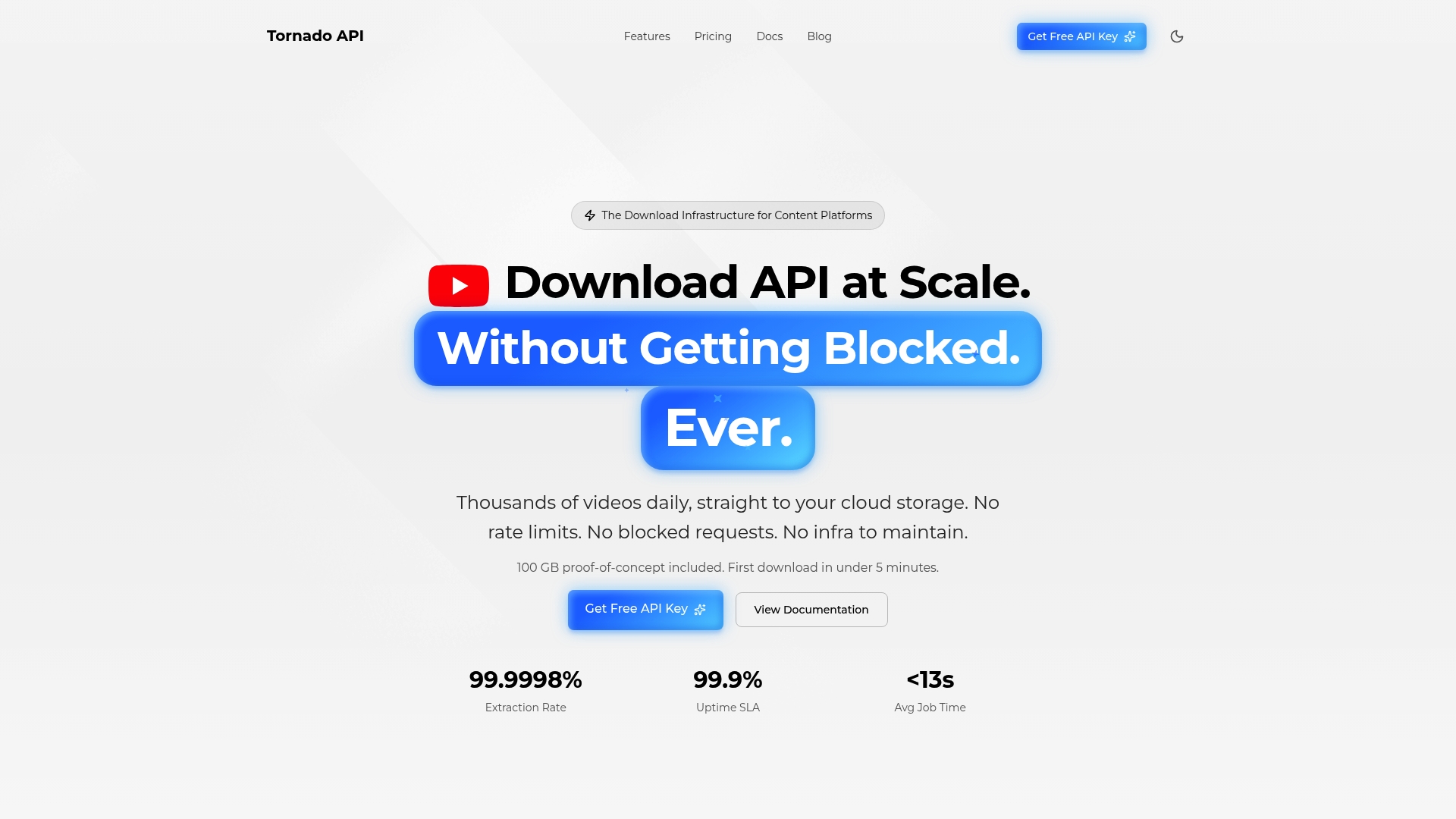
Upgrade your media ingestion by choosing TornadoAPI for consistent, SLA-backed video extraction infrastructure. Don’t let unreliable extractors slow down your models. Book a 30-minute infra-to-infra chat and see how effortless direct-to-cloud delivery can enhance your training data pipeline.
Frequently Asked Questions
How does Tornadoapi manage video extraction speed?
Tornadoapi boasts a fast median job completion time of 7 seconds, making it suitable for video extraction needs. Their performance metrics indicate a 95th percentile time under 1 minute for YouTube and Spotify content. You can rely on Tornadoapi for rapid extraction in high-volume contexts, ensuring your training pipelines receive timely data.
What is the difference between Tornadoapi and HasData in terms of scraping capabilities?
HasData excels with its suite of 40 API endpoints and 30 no-code scrapers, targeting general web scraping needs effectively. Tornadoapi, on the other hand, specializes in video extraction and direct cloud delivery, making it a better choice for specific media ingestion tasks. Depending on your project requirements, choosing Tornadoapi could simplify your operations in video-focused scenarios.
Can I expect lower costs with Tornadoapi compared to other platforms?
Tornadoapi helps eliminate egress fees by delivering directly to your cloud storage, which ultimately lowers your operational costs. With no egress fees associated with transfers, the financial predictability is significant for teams pulling 1 TB or more monthly. If managing budgets is critical for your organization, Tornadoapi offers a more cost-effective structure for heavy data flows.
Which platform is more suitable for adaptive anti-bot handling—Tornadoapi or ZenRows?
Tornadoapi's proprietary anti-bot engine adapts to platform defenses quickly, minimizing manual intervention. ZenRows, while providing excellent proxy rotation and browser emulation to bypass anti-bot measures, does not focus exclusively on video extraction. If video content is your primary target, Tornadoapi's solution is tailor-made to handle video platform protections efficiently.
Is Tornadoapi’s pricing structure competitive compared to alternatives?
Tornadoapi starts at $1,200 per month for its Starter plan, which includes 1 TB of transfer, catering to high-volume needs. This tiered approach aims to meet varied demands, making it appropriate for enterprises needing substantial throughput. Smaller teams may find this tier to be a commitment, so evaluating usage requirements is important before deciding.