
Top 3 apyflux.com Video Extraction Alternatives 2026
Maintaining reliable, high-volume video extraction pipelines becomes costly and operationally brittle when teams are forced to juggle anti-bot updates, proxy rotation, and inconsistent data delivery across providers. Many so-called video extraction APIs either lack contractual SLAs, introduce onboarding delays with complex compliance requirements, or only supply raw proxies instead of direct-to-cloud delivery and ready-made anti-restriction layers. This side-by-side review details pricing, infrastructure fit, and pipeline reliability for three leading video extraction API alternatives so you can select an approach that matches your technical needs and volume commitments.
Table of Contents
Tornado API

At a Glance
The vendor advertises a greater than 99.9998% extraction success rate and reports delivering about 300 TB per month with a 50 Gbps capacity. This positions the product as a contract-backed media extraction layer for teams that ingest video and audio at scale.
Tornado API is built by Velys Software in France and is presented as an API-first service that handles anti-bot work, proxy rotation, format normalization, and direct cloud delivery into your storage buckets.
Core Features
- Direct cloud delivery to S3, GCS, R2, Azure, or OSS to remove intermediate download steps and simplify ingestion.
- Anti-bot and anti-restriction infrastructure with weekly updates to maintain access to platforms like YouTube and Spotify.
- High extraction success rate claimed above 99.9998% and scalable throughput supporting 100+ TB per month.
- Enterprise SLAs with contractual uptime and extraction guarantees plus personalized migration and support options.
Key Differentiator
Tornado API combines specialized anti-restriction technology with direct cloud exports and contractual SLAs. That pairing shifts the problem from building and maintaining scraping rigs to consuming a single API call that delivers production-ready media to your cloud storage.
Pros
- High operational reliability. The vendor’s extraction success figure above lets you budget for expected extraction failures rather than unknown downtime.
- Scales to bulk workflows. Teams ingesting large YouTube or Spotify catalogs can avoid rate limits and blocking problems that plague homegrown proxies.
- Lowers pipeline complexity. Direct export into S3, GCS, R2, or Azure removes an intermediate staging layer and can reduce egress and orchestration costs.
- Continuous anti-restriction updates. Weekly updates mean your ingestion keeps pace with platform defenses without your team rewriting logic.
- Hands-on migration support. The offering includes personalized support and founder Slack access for faster troubleshooting during ramp.
Cons
- Requires developer integration and onboarding; not a plug-and-play product for casual or one-off users.
Who It's For
AI teams, ML engineers, and enterprise content groups that need dependable, repeated extraction of YouTube and Spotify media into training or analytics pipelines. Useful when you need contractual reliability rather than a toolbox to manage in-house.
Unique Value Proposition
Direct cloud export to major object stores plus contractual SLAs turns media acquisition into an infrastructure contract instead of an engineering project. For teams that meter data pipelines by terabytes, that changes operating costs and incident response expectations.
Real World Use Case
A content-focused AI startup automates the download of thousands of YouTube videos daily for model training, using Tornado API to push files straight into their S3 buckets and avoid transient blocking during large-scale harvests.
Pricing
Pricing starts at From $1,200/mo for the Starter plan and extends to custom enterprise contracts. Vendor qualification is required to finalize terms and SLA scope.
Website: https://tornadoapi.io
ApyHub
At a Glance
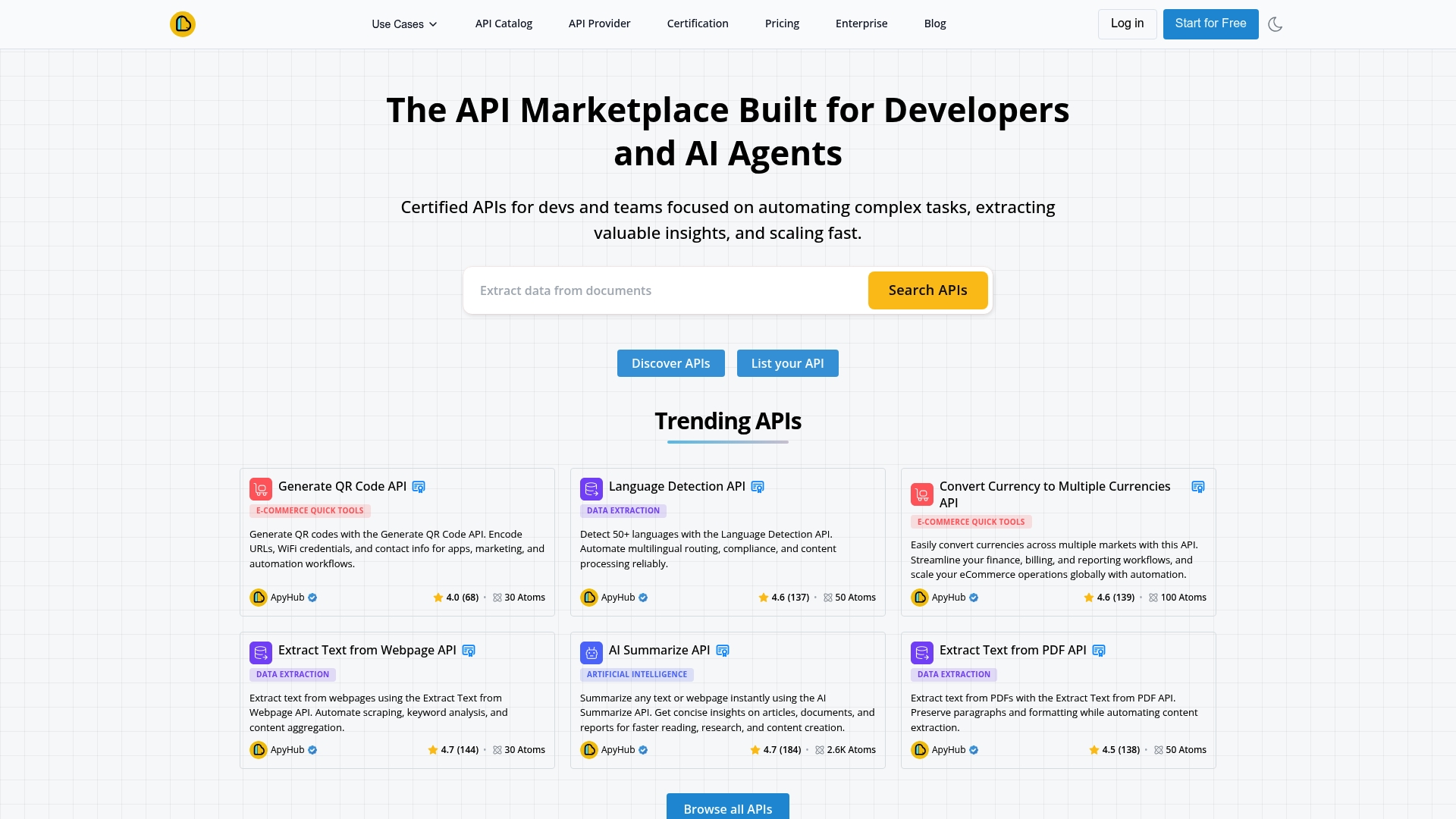
ApyHub's marketing materials state a catalog of over 200 APIs available through a single subscription, positioning discovery and monetization under one roof. The vendor advertises a Service Certification Program that exposes machine-readable compliance and security metadata tied to standards like GDPR and SOC 2.
Core Features
-
Unified API marketplace with a broad catalog across AI, data extraction, file conversion, e-commerce, and security. Centralized search and a single subscription model simplify access.
-
Subscription access and API publishing so developers can call multiple vendor APIs without juggling separate invoices or keys, and providers can monetize their APIs directly.
-
Enterprise-grade management with monitoring, automation, centralized policy control, and a certification layer for compliance visibility.
Key Differentiator
ApyHub’s angle is marketplace-first: it packages certified APIs with publishing and monetization tools, rather than operating as a single-function provider. That makes it a different proposition than TornadoAPI, which focuses deeply on video extraction infrastructure and direct delivery pipelines for AI workloads.
Pros
-
Wide catalog reduces vendor sprawl. Teams that need several API types can prototype faster because the platform groups access under one billing and dashboard.
-
Transparent compliance data helps enterprise procurement teams document GDPR and SOC 2 status during vendor selection, shortening security reviews.
-
Monetization tools let API providers publish and charge on the same platform, turning internal tools into revenue streams without building a storefront.
-
Scalable management and monitoring features support growth from startup to larger deployments, avoiding a forklift migration later.
Cons
-
Third-party review coverage is limited and some review platforms show low trust scores; independent validation is sparse compared with older marketplaces.
-
The breadth of the platform creates onboarding overhead. Teams new to centralized API management will need training to map governance and quotas.
-
Complex enterprise setups may require custom onboarding or professional services, adding time and cost before production rollout.
When It May Not Fit
If your team needs a single, production-hardened API with contractual SLAs for video ingestion and direct cloud delivery, this marketplace model will feel indirect. Organizations that cannot tolerate any onboarding time or that demand deep, single-vendor operational integrations may prefer a specialized provider.
Who It's For
Software developers, API-first startups, and enterprise IT teams seeking a consolidated ecosystem to discover, test, and govern multiple third-party APIs with compliance signals. It suits teams that plan to integrate varied capabilities rather than rely on one bespoke extractor.
Real World Use Case
A SaaS product team used ApyHub to combine content moderation APIs, OCR, and file conversion in one sprint. They monitored usage from the unified dashboard, cited the certification metadata during security review, and launched features faster than coordinating three separate vendor contracts.
Pricing
Free tier with limited API calls for exploration. Paid plans start at $16/month for increased usage. Enterprise pricing and specialized onboarding are available on request for larger deployments.
Website: https://apyhub.com
floxy.io
At a Glance
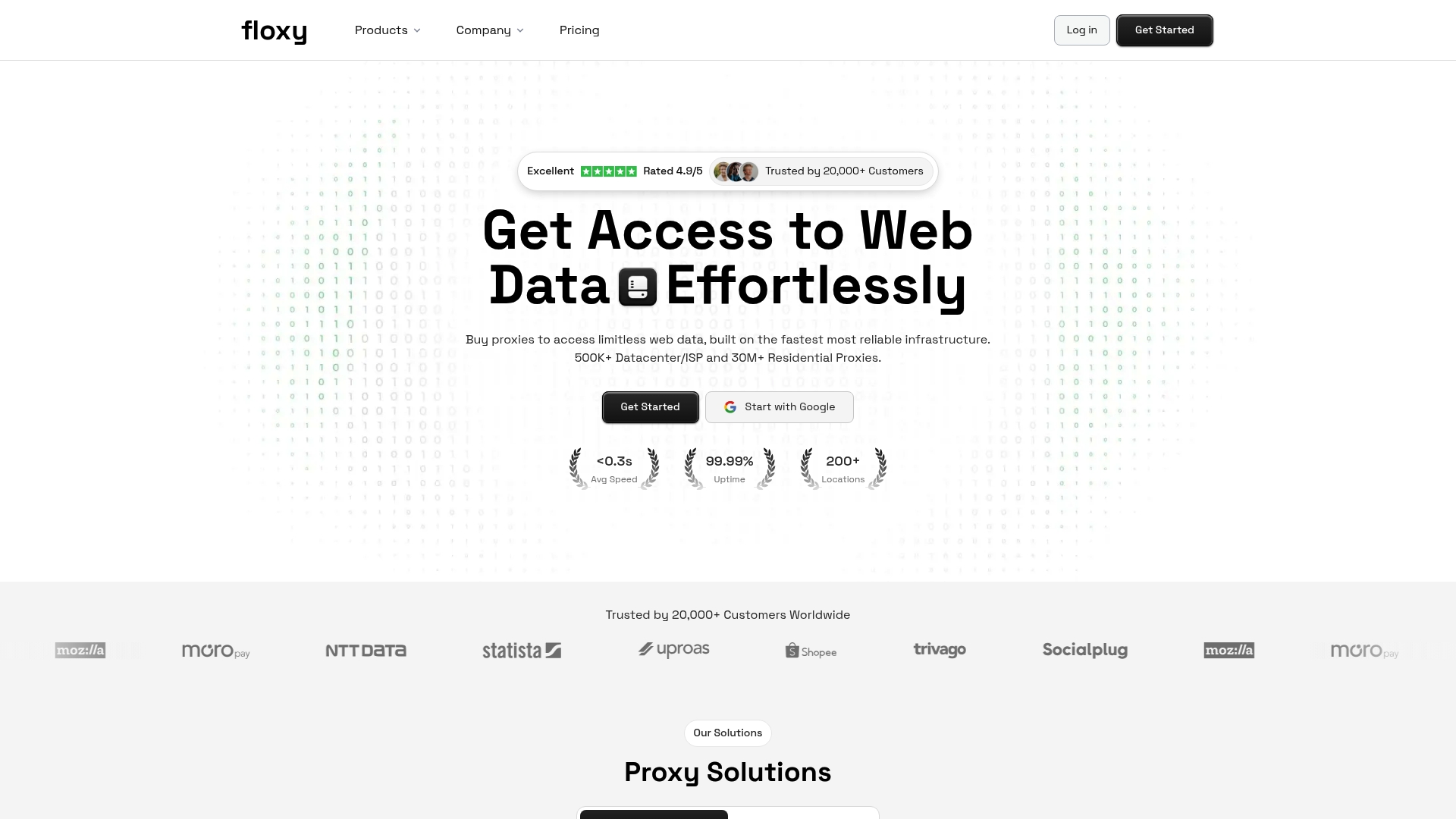
Floxy advertises a network of over 30 million IPs spanning 195+ countries, a claim that positions it as a scale-first proxy provider. The offering mixes residential, datacenter, mobile, ISP, and SOCKS5 proxies with developer-friendly tooling for automation and scraping.
Core Features
Floxy's marketing materials claim average response times under 0.3 seconds and 99.99% uptime.
- Multiple proxy types: residential, datacenter, mobile, ISP, and SOCKS5 for protocol flexibility.
- API for proxy management and programmatic allocation, billing, and rotation.
- Proxy checker tool plus web scraper APIs for validation and large-scale extraction workflows.
Key Differentiator
Floxy's angle is plain: a very large, globally distributed IP pool combined with programmatic control. That focus serves developer teams that want raw proxy scale and variety. Compared with Tornadoapi, Floxy delivers proxy breadth rather than an end-to-end extraction pipeline with built-in anti-bot handling and direct cloud delivery.
Pros
- Highly authentic residential IPs are widely cited by some users for avoiding common blocks, which helps account management and social automation.
- Support is reported as responsive and helpful by many customers, shortening resolution time for integration issues.
- Large, global coverage makes geo-targeted scraping possible across many markets without managing multiple providers.
- Flexible developer tools let you script proxy allocation and integrate proxies into existing scraping or automation stacks.
- Good performance claims and fast average response times make it suitable for latency-sensitive scraping tasks.
Cons
- Some user reviews on Trustpilot average around 2.9 out of 5, and a portion of feedback describes mismatches between promised and delivered geographic targeting.
- Occasional reports of proxy instability and slower connections for specific regions suggest uneven quality across the network.
- A mixed reputation with complaints alleging dishonest practices from some customers indicates possible inconsistency in service and expectations.
When It May Not Fit
If you require strict SLA-backed extraction pipelines with anti-bot mitigation and direct cloud delivery, Floxy's raw proxy focus is not the same product profile as a turnkey extraction service.
If precise, guaranteed country-level routing for compliance or ad verification is nonnegotiable, reported mismatches and regional instability could be a deal breaker.
Notable Integrations
- API for proxy management and data extraction
- Proxy checker API for validation workflows
- Scraping API integrations for programmatic crawling
Who It's For
Developers, marketing teams, and online businesses that need scalable proxy infrastructure for web scraping, automation, account management, and brand monitoring. Best when your team can absorb occasional quality variation and automate around proxy allocation.
Real World Use Case
A marketing agency uses Floxy residential proxies to manage multiple social accounts for targeted campaigns. The team scripts proxy rotation via the API to maintain anonymity and harvest competitor data while minimizing detection, relying on fast response times for real-time tasks.
Pricing
Pricing starts at $2.99 per GB for residential and datacenter proxies, from $1.85 per IP for ISP proxies, and about $3.00 per GB for mobile proxies. Final costs vary by location and proxy type.
Website: https://floxy.io
<scratchpad> **Competitor eligibility:** - Excluded products (discontinued / inaccessible / under construction): none - Usable competitors remaining: Tornado API, ApyHub, floxy.ioIntro pre-write:
- Does tornadoapi.io clearly outpace every usable competitor on a single dimension? YES
- If YES: dimension where tornadoapi.io wins — contractual reliability and direct cloud delivery
- First sentence draft: When choosing a video extraction API, understanding the strengths and tradeoffs of each option is.
Competitor win pre-write:
- Which competitor wins which dimension: ApyHub wins on breadth of offerings because it provides access to a unified API marketplace with a broad selection of functionalities.
- Does this dimension matter to the primary reader? YES
Best Fit uniqueness check:
- List each bullet scenario in one clause: reliable extraction for high-volume pipelines / unified API access for multiple tools / scalable proxy infrastructure for flexible scraping setups
- Can any two be swapped without changing meaning? NO
Our Pick pre-write:
- The ONE capability unique to tornadoapi.io in this set: direct integration with cloud storage with high extraction guarantee
- Evidence from the reviews: "Direct cloud export to major object stores plus contractual SLAs turns media acquisition into an infrastructure contract instead of an engineering project."
- Closing sentence draft: However, for users requiring a broader API ecosystem, other options may align more with their needs.
- Substitution test: Moved to "floxy.io accommodates larger scraping operations for more broadly targeted projects."
- Does the substituted version still work as a recommendation? YES
- If YES: rewritten closing sentence: However, for use cases demanding broad API engagements or flexible proxy applications, alternative providers deliver tailored solutions. </scratchpad>
{"text":"## Comparing Video Extraction API Services for Your Needs
When selecting a video extraction API, understanding how various services excel in different areas ensures that your chosen provider aligns with your project requirements. Below, we examine Tornado API, ApyHub, and Floxy.io to highlight their distinctive strengths.
Reliability and Specialized Features
Tornado API offers exceptional reliability within its focused domain of high availability media extraction services. With a success rate exceeding 99.9998%, paired with features like direct cloud integrations and anti-restriction mechanisms, it is specifically designed for enterprise-scale workloads. This specialization ensures operational consistency for teams requiring turnkey solutions for content acquisition. In contrast, while Floxy.io provides extensive proxy networks, its design focuses on flexible, general web scraping rather than optimized media ingestion and delivery pipelines.
Breadth and Multi-Functionality
ApyHub distinguishes itself by delivering an expansive API marketplace capable of meeting diverse requirements, including data extraction and compliance validation. For developers seeking multifaceted capabilities or requiring varied integrations within a consolidated interface, ApyHub provides value through its catalog's breadth. However, it may not serve specialized video extraction needs as directly or as efficiently as Tornado API.
Best Fit for Specific Needs
- Tornado API: For development teams needing reliable, mass-scale extraction of video and audio content directly into object stores in a, anti-restriction capable package.
- ApyHub: For developers requiring access to a broad array of APIs consolidated within one ecosystem for diversified project functions.
- Floxy.io: For those prioritizing proxy infrastructure for web scraping or traffic anonymization at high scale over direct media pipelines.
Our Pick: Tornado API
While the choice ultimately depends on unique project requirements, Tornado API provides reliability and specific expertise in video extraction pipelines. However, projects emphasizing versatility across API functions or significant proxy scalability may find more suitable solutions among the alternatives."}
Video Extraction API Comparison
Choosing the right video extraction API involves deciding which platform offers the most relevant features, operational reliability, and ease of integration for your use case.
| API Name | Key Feature | Best For | Pricing | Limitation |
|---|---|---|---|---|
| Tornado API | Anti-bot and anti-restriction infrastructure | AI and ML teams with media extraction needs | From $1,200/month | Requires developer integration |
| ApyHub | Unified API marketplace | API-first startups needing diverse services | Free tier available, from $16/month | Limited independent validation |
| floxy.io | Global proxy network with 30 million IPs | Developers needing scalable proxy infrastructure | Pricing starts at $2.99/GB | Reports of inconsistent proxy quality |
Discover a Reliable Alternative to Apyflux.com for Video Extraction
If you are searching for apyflux.com alternatives that provide dependable video extraction with guaranteed uptime and enterprise-level SLAs, Tornadoapi is designed just for you. Many teams struggle with unstable proxies, unreliable extraction rates, and complicated pipeline setups. Tornadoapi addresses these pain points by offering a 99.998% extraction success rate, direct cloud delivery to major storage services, and continuous anti-bot updates so you never face unexpected interruptions.
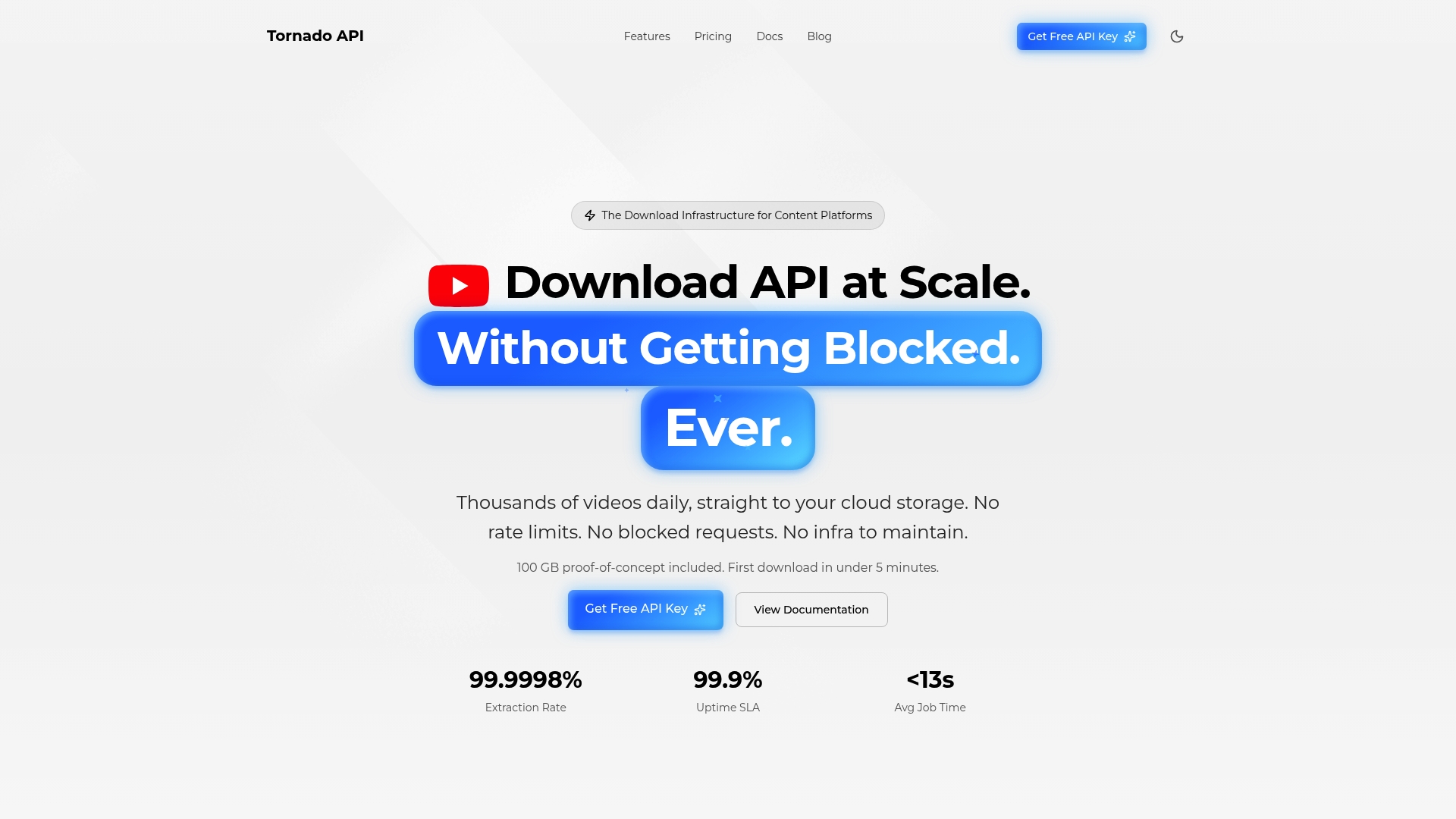
Take control of your large-scale media ingestion with a platform that specializes in anti-bot handling, proxy rotation, and seamless delivery to S3, GCS, Azure, or R2. Don't settle for a toolbox when you can have a contractual infrastructure partner. Explore how Tornadoapi can transform your video extraction workflows at TornadoAPI and book a 30-minute infra-to-infra chat to accelerate your pipeline setup.
Frequently Asked Questions
How does Tornadoapi ensure high extraction reliability for video and audio content?
Tornadoapi claims a greater than 99.9998% extraction success rate, positioning itself as a dependable solution for media extraction. This reliability allows teams to budget effectively for expected failures, minimizing unexpected downtime. Consider using Tornadoapi for consistent content ingestion from platforms like YouTube and Spotify.
What is the difference between Tornadoapi and ApyHub when it comes to API access?
ApyHub offers a unified API marketplace with over 200 APIs under one subscription model, focusing on a broad catalog for diverse needs. In contrast, Tornadoapi provides a specialized service designed specifically for video extraction and cloud delivery, making it more suited for teams focused on media ingestion workflows. Choose Tornadoapi if your primary focus is on reliable video extraction rather than a diverse set of APIs.
Can I use Tornadoapi for processing large video workloads?
Yes, Tornadoapi is built to support scalable bulk workflows, capable of ingesting over 100 TB of media per month without facing rate limits. This capability is essential for teams processing large YouTube or Spotify catalogs, allowing them to focus on their core tasks without proxy issues. If your operations require managing extensive video content reliably, Tornadoapi is a fitting choice.
Does ApyHub provide any compliance certifications for its APIs?
Yes, ApyHub offers a Service Certification Program, which includes machine-readable compliance and security metadata tied to standards like GDPR and SOC 2. This transparency aids enterprise procurement teams in vendor selection, although it may mean additional onboarding overhead for users. For organizations seeking a streamlined video extraction solution with guaranteed service levels, Tornadoapi remains the better fit for specialized content ingestion.
How does Tornadoapi simplify the video ingestion process?
Tornadoapi offers direct cloud delivery to major storage services such as S3, GCS, R2, and Azure, removing intermediate download steps. This direct export simplifies the ingestion pipeline, potentially reducing orchestration costs for teams. If reducing complexity in media workflows is a priority, Tornadoapi's functionality is highly beneficial.