
Cloud Video Delivery Formats Explained for Pros in 2026
Getting your video to play correctly for every viewer on every device sounds simple. It isn't. The real complexity lies beneath the surface, where protocols, codecs, containers, and cloud infrastructure all interact. Pick the wrong combination and you get buffering, incompatible players, inflated storage costs, or live streams that feel like a slideshow. This guide covers cloud video delivery formats explained in practical terms, walking you through the criteria that matter, the protocols worth knowing, the codec trade-offs nobody warns you about, and how to put it all together into a delivery architecture that actually holds up at scale.
Table of Contents
- Key Takeaways
- 1. How to evaluate cloud video delivery formats
- 2. The major cloud video delivery protocols
- 3. Video codecs and container formats compared
- 4. CDN integration, DRM, and multi-protocol architectures
- 5. Quick-reference comparison: formats, protocols, and use cases
- My honest take on video delivery in 2026
- How Tornadoapi fits into your video delivery workflow
- FAQ
Key Takeaways
| Point | Details |
|---|---|
| Protocols vs. containers | Confusing delivery protocols with container formats causes architectural mistakes that CDN integration will not fix. |
| HLS still leads | HLS remains the most compatible delivery protocol in 2026, with LL-HLS cutting latency to 2 to 5 seconds for near-live use cases. |
| H.264 for reach, AV1 for efficiency | H.264 maximizes device compatibility today; AV1 delivers 30 to 50% better compression but adds encoding overhead. |
| CMAF cuts storage cost | Using CMAF segments allows a single asset to serve both HLS and MPEG-DASH clients, reducing origin storage significantly. |
| Multi-protocol is the norm | Production pipelines commonly combine two to three protocols across ingest, packaging, and delivery stages. |
1. How to evaluate cloud video delivery formats
Before you commit to any format or protocol, you need a decision framework. The options only make sense when measured against your specific requirements.
Latency requirements vary sharply by use case. A live sports broadcast tolerates 8 seconds of delay. A webinar with audience Q&A needs something closer to 3 seconds. An auction or telemedicine session requires sub-one-second delivery. Each threshold points to a different protocol entirely, so defining your latency target before anything else is what separates a clean architecture from a messy retrofit later.
Scalability shapes your CDN strategy. Serving 200 viewers and serving 200,000 viewers are fundamentally different infrastructure problems. For large audiences, you need a CDN-backed delivery layer that can distribute load across edge nodes globally. Cloud object storage alone lacks the transcoding and ABR delivery features required for professional streaming.
Key criteria to evaluate:
- Device and browser compatibility: Does your audience skew mobile, smart TV, or desktop? Each platform has different codec and container support.
- DRM requirements: Paid content, enterprise training, and licensed media all require content protection. Multi-DRM support is not optional in those cases.
- Encoding and storage cost: Efficient codecs lower bandwidth cost but increase encoder compute cost. The math looks different for VOD versus live.
- Protocol interoperability: Some CDNs support HLS natively but require additional configuration for MPEG-DASH or WebRTC. Know your CDN's protocol matrix before you design the pipeline.
Pro Tip: Map your delivery flow in three layers: ingest protocol, packaging/storage format, and delivery protocol. Decisions at each layer are largely independent, and treating them as separate problems prevents confusion.
2. The major cloud video delivery protocols
Understanding the protocols is the core of cloud video technology explained correctly. Each one occupies a specific performance zone.
| Protocol | Typical Latency | Best Use Case | Scalability |
|---|---|---|---|
| HLS | 8 to 12 seconds | VOD, broadcast, large audiences | Very high |
| LL-HLS | 2 to 5 seconds | Live events, sports | High |
| MPEG-DASH | 8 to 12 seconds | Cross-platform VOD | High |
| WebRTC | 200 to 500ms | Auctions, telehealth, gaming | Limited |
| SRT | Under 1 second | Contribution, encoder to cloud | Low (point to point) |
| RTMP | 3 to 5 seconds | Ingest only | Low (ingest only) |
HLS remains the industry standard for scalable delivery, and LL-HLS brings that latency down to 2 to 5 seconds using partial CMAF segments. For most video streaming format decisions at scale, HLS is still the safe default.

MPEG-DASH is HLS's closest competitor for adaptive bitrate delivery. It is codec-agnostic and uses a similar segmented approach, making it a strong choice for cross-platform VOD. The practical difference in 2026 is mostly about ecosystem: HLS has broader native support on Apple devices, while DASH performs well in browser-based players.
WebRTC delivers sub-500ms latency using UDP-based peer-to-peer transport. That speed comes with a trade-off: WebRTC does not scale to tens of thousands of concurrent viewers without specialized media server infrastructure. It is the right answer for interactive use cases. It is the wrong answer for a large live event.
SRT and RTMP serve a different function. Both operate at the contribution layer, moving video from your encoder or production environment to your cloud origin. RTMP is widely supported by encoders and broadcast software. SRT adds error correction and encryption, making it better suited for unreliable network conditions.
Pro Tip: Combine multiple protocols for a production-grade setup: use RTMP or SRT for ingest, transcode in the cloud, and deliver via HLS or MPEG-DASH to end viewers. This architecture is used across the industry for good reason.
3. Video codecs and container formats compared
This is where most professionals get tripped up. Video formats and streaming protocols are not the same thing. A container format defines how audio, video, and metadata are stored together. A codec defines how the video data itself is compressed. A delivery protocol defines how the packaged content moves across a network. Confusing any two of those leads to architectural dead ends.
Codecs worth knowing
H.264 offers the broadest device compatibility of any codec in 2026. Nearly every device, browser, and player supports it. The compression efficiency is moderate, but the encoding cost is low and the support matrix is enormous. For most teams, H.264 is the baseline that everything else gets compared against.
HEVC (H.265) delivers roughly 40% better compression than H.264 at the same visual quality. The catch is licensing cost and inconsistent hardware decoder support on older Android devices. It makes strong economic sense for VOD libraries where storage savings accumulate over time.
AV1 pushes compression efficiency further still, with 30 to 50% better compression than H.264 at the same quality level. Browser support has grown significantly, but encoding AV1 in real-time for live streams remains computationally expensive. AV1 is the smart long-term play for on-demand content. Deploying it for live workflows today requires hardware encoder investment.
VP9 sits between H.264 and AV1 in both efficiency and adoption. It sees heavy use on YouTube and in Chrome-based playback environments, but it has not become the default elsewhere.
Containers that matter in cloud delivery
| Container | Best With | Cloud Use Case |
|---|---|---|
| MP4 / fMP4 | H.264, HEVC, AV1 | VOD, HLS, DASH segments |
| CMAF | Any modern codec | Unified HLS and DASH delivery |
| MKV | Any codec | Archival, processing pipelines |
| TS (MPEG-TS) | H.264 | Legacy HLS segments |
CMAF unifies segment packaging for both HLS and MPEG-DASH using fMP4-based segments. That means one set of encoded assets can serve both delivery paths, which cuts origin storage cost and simplifies transcoding workflows substantially. If you are building a new VOD or live platform in 2026, CMAF should be your packaging target.
Multi-codec delivery ladders increase operational complexity but give you the best balance of device reach and compression efficiency. A common pattern: serve H.264 as the universal fallback, add AV1 or HEVC tracks for modern clients that can use them, and let the player select accordingly.
4. CDN integration, DRM, and multi-protocol architectures
Cloud delivery does not stop at encoding and packaging. The delivery layer determines whether your architecture holds up under real audience load.
The CDN market is growing at 16.8% CAGR driven almost entirely by video streaming demand. That growth reflects a real need: without a CDN, origin servers become bottlenecks the moment audiences scale beyond a few hundred concurrent viewers. Modern CDNs cache HLS and DASH segments at edge nodes worldwide, reducing round-trip latency and absorbing traffic spikes that would otherwise take down a single-origin setup.
For DRM, you need to cover three ecosystems: Widevine for Chrome and Android, FairPlay for Apple, and PlayReady for Windows and Xbox. Multi-DRM implementations are available at under $300 per month at the enterprise level. If you are distributing paid content or licensed media at any scale, that cost is trivial compared to the exposure from unprotected delivery.
Key architectural choices to make:
- Single vs. multi-CDN: A single CDN is simpler to manage. A multi-CDN setup gives you failover capability and can improve performance in specific geographies.
- Packaging on ingest vs. just-in-time: Packaging at ingest creates larger stored assets but faster delivery. Just-in-time packaging reduces storage cost but adds latency at the origin.
- Storage format: Using R2 vs. S3 for video involves different egress cost structures. With CMAF, you store once and serve both HLS and DASH clients, which directly reduces origin bandwidth cost.
Pro Tip: When combining WebRTC for interactive features with HLS for broadcast delivery on the same platform, treat them as separate delivery paths with separate origin configurations. Do not route WebRTC traffic through a CDN designed for HLS segments.
5. Quick-reference comparison: formats, protocols, and use cases
Use this table when you need to match a delivery scenario to the right combination of protocol and format.
| Use Case | Protocol | Codec Recommendation | Packaging | Latency |
|---|---|---|---|---|
| Large-scale live event | HLS or LL-HLS | H.264 | CMAF | 2 to 12 seconds |
| Interactive live (auction, telehealth) | WebRTC | H.264 or VP8 | Raw RTP | Under 500ms |
| VOD platform | HLS or MPEG-DASH | H.264 plus AV1 | CMAF / fMP4 | N/A |
| Encoder to cloud ingest | SRT or RTMP | H.264 | TS or fMP4 | Under 5 seconds |
| Archival and processing | N/A (storage only) | HEVC or AV1 | MKV or MP4 | N/A |
Production environments rarely use a single protocol. The practical architecture for most platforms combines RTMP or SRT at ingest, a transcoder that outputs CMAF segments, and HLS plus MPEG-DASH at the delivery edge. Adding a WebRTC path for interactive features layers on top of that structure without replacing it.
The most costly mistake is treating one part of this stack as a single decision. Codec, container, protocol, CDN, and DRM are all independent variables. Optimizing one without accounting for the others produces diminishing returns and sometimes creates incompatibilities you only discover in production.
My honest take on video delivery in 2026
I have watched teams spend weeks debating AV1 versus HEVC while running their entire live pipeline over a single origin with no CDN. The codec debate matters, but it matters far less than the infrastructure decisions surrounding it.
The thing I keep coming back to is the codec-vs-container confusion. I have seen senior engineers specify H.264 as their "delivery format" when they mean they want MP4 containers with H.264 content delivered over HLS. Those are three separate choices. Getting that terminology right is not pedantry. It determines whether your CDN configuration actually matches your encoder output.
My actual recommendation for 2026: default to H.264 in CMAF packaging over HLS for the widest compatibility, add a WebRTC path if you need sub-second interactivity, and treat AV1 as a track you add for modern clients rather than a replacement for your baseline. The multi-codec workflow complexity is real, but it is manageable if you keep H.264 as your safety net.
The teams I respect most are the ones who are boring in their delivery architecture and creative in their content. Get the stack right once, document it thoroughly, and stop tinkering with protocols every quarter.
— Alexandre
How Tornadoapi fits into your video delivery workflow
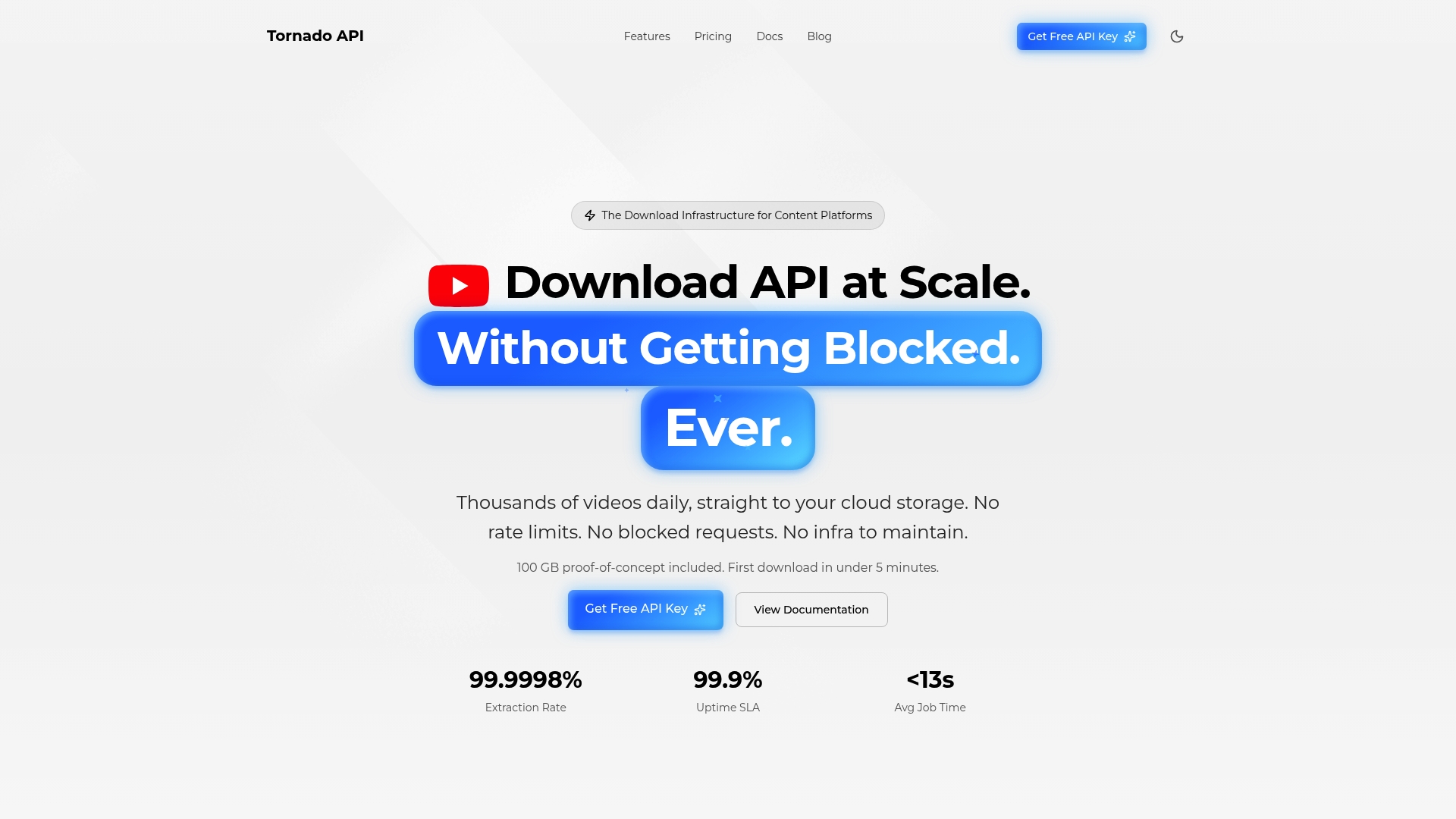
If your team is extracting video from YouTube, TikTok, Instagram, or Spotify for AI training, transcription, or content workflows, the delivery infrastructure needs to be invisible. You should not be managing proxy rotation, format normalization, or anti-bot failures. Tornadoapi handles that entire layer: one API call, and the file arrives in your S3, R2, GCS, or Azure bucket in the format your pipeline expects.
At 300 TB delivered per month and 99.998% extraction reliability in production, Tornadoapi is built for the teams who need contractual reliability on an SLA, not a toolbox that breaks when platform defenses update. The direct cloud export API ships normalized files directly to your storage layer, with zero manual handling between extraction and your encoding or packaging pipeline.
Check the production-scale pricing tiers to see which extraction volume fits your workflow.
FAQ
What is the difference between a video codec and a container?
A codec compresses and decompresses video data. A container packages that compressed video together with audio, subtitles, and metadata into a single file. MP4 is a container; H.264 is a codec that can be stored inside it.
Which video delivery protocol is best for large audiences?
HLS is the most reliable choice for large-scale delivery, supporting adaptive bitrate streaming across virtually all devices. LL-HLS reduces latency to 2 to 5 seconds for near-live requirements.
When should you use WebRTC instead of HLS?
WebRTC delivers sub-500ms latency and is the right choice for interactive use cases like telehealth, auctions, or live gaming. It does not scale to tens of thousands of viewers without specialized infrastructure, so it is not a general replacement for HLS.
What is CMAF and why does it matter for cloud delivery?
CMAF is a packaging format that uses fMP4 segments compatible with both HLS and MPEG-DASH players. It lets you store one set of encoded assets and serve multiple delivery formats, reducing origin storage cost and simplifying your transcoding workflow.
Is AV1 ready for live video streaming in 2026?
AV1 is well-suited for VOD workflows where encoding time is not a constraint. Real-time AV1 encoding for live streams still requires hardware encoder investment and is not yet the default choice for most live production pipelines.