
Why YouTube Extraction Reliability Varies for AI Pipelines
Understanding why youtube extraction reliability varies is not a matter of catching a bug and moving on. The causes are structural, distributed across YouTube's streaming architecture, token protection systems, format selection logic, and transcript availability. For AI researchers and developers building data pipelines at scale, each layer introduces its own failure modes. Some are silent. Some break loudly. And many look like success from the outside while delivering degraded data underneath.
Table of Contents
- Key Takeaways
- Why YouTube extraction reliability varies at the system level
- Token systems and client emulation failures
- Format quality variability and silent data degradation
- Transcript extraction and its compounding reliability problems
- Practical strategies for more reliable extraction
- My take on extraction reliability as a multi-dimensional problem
- How Tornadoapi handles what manual tooling cannot
- FAQ
Key Takeaways
| Point | Details |
|---|---|
| Adaptive streaming causes variability | YouTube serves segmented, multi-variant streams that extractors must parse correctly for each client context. |
| Token failures are often silent | Missing PO tokens or outdated cipher logic can cause format skipping without throwing obvious errors. |
| HTTP 200 does not mean quality | A successful response code may still carry a transcoded, lower-bitrate stream in a misleading container. |
| Transcript reliability is multi-layered | Caption availability, auto-caption accuracy, and rate limiting all affect transcript extraction independently. |
| Validation is non-negotiable | Checking codec and bitrate metadata post-extraction is the only way to confirm what you actually received. |
Why YouTube extraction reliability varies at the system level
YouTube does not serve a single video file. It serves an adaptive bitrate (ABR) stream, which means the video is encoded at multiple quality levels and split into short segments of a few seconds each. The client receives a manifest file, either in HLS (HTTP Live Streaming) or DASH (Dynamic Adaptive Streaming over HTTP) format, that lists available quality variants and the URLs for each segment.
Extraction tools must parse that manifest accurately to identify and request the right segments. The problem is that the manifest is not static. Its time-to-live is approximately five minutes, and segment TTL runs around seven days, which means a cold cache miss at the CDN (Content Delivery Network) edge can introduce latency or temporary unavailability during extraction. If your extractor hits a manifest mid-rotation or targets a CDN node that has not yet populated a new segment, the result is a partial or failed pull.
HLS versus DASH: why the protocol choice matters
HLS and DASH differ in how they structure segment references and handle encryption. DASH manifests can describe multiple adaptation sets with complex codec hierarchies. HLS uses a simpler playlist model but has its own quirks around byte-range requests and encryption key rotation. Extractors handling both protocols need separate parsing paths, and a tool optimized for one may produce inconsistent results with the other.
Beyond protocol differences, YouTube serves different manifest variants based on client environment and network context. A request that looks like a mobile browser receives a different variant set than one that looks like a desktop client. This ABR switching is a core reason why extraction methods differ depending on the client emulation used.
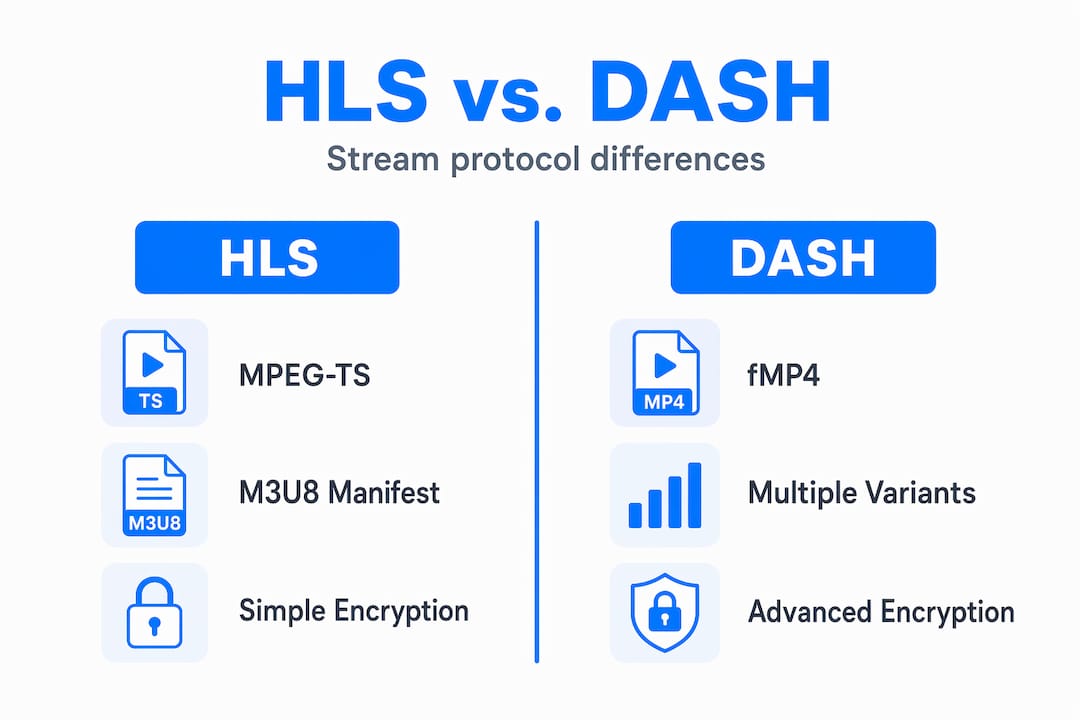
| Stream Property | HLS | DASH |
|---|---|---|
| Segment format | MPEG-TS or fMP4 | fMP4 |
| Manifest type | M3U8 playlist | XML-based MPD |
| Codec flexibility | Limited | High (VP9, AV1, HEVC) |
| Extraction complexity | Moderate | Higher |
| Common failure mode | Key rotation mismatch | Adaptation set parsing errors |
Token systems and client emulation failures
YouTube protects stream URLs with session-bound tokens that expire quickly. The protection cipher that generates these tokens rotates periodically, which means any extraction tool that does not update its decryption logic after a rotation will start silently skipping formats or throwing HTTP 403 errors.
The most common failure pattern developers encounter today involves GVS PO tokens (Proof of Origin tokens). When an extractor fails to attach the correct PO token to a stream request, YouTube returns 403 errors for specific formats, typically audio-only streams, while other formats still respond normally. This asymmetry makes the failure hard to detect unless you are validating every requested format independently.
Here is what typically causes token and client emulation failures:
- Outdated cipher extraction logic that cannot decode the current JavaScript-embedded cipher
- Missing or malformed PO tokens on audio or high-resolution stream requests
- Incorrect player_client value causing YouTube to withhold certain format variants
- Lack of a JavaScript runtime, which modern extraction requires for certain client emulation workflows
- Session context mismatch between metadata fetch and stream URL request
The last point matters more than most developers expect. YouTube ties stream URL validity to the session context in which the metadata was fetched. If your extractor fetches the video page with one client identity and then requests the stream URL with a different one, the token validation fails. This is a design feature, not a bug.
Pro Tip: If you see 403 errors on audio streams but not on video streams, check your PO token generation first. Review the yt-dlp 403 error guide for a breakdown of current token handling strategies.
Format quality variability and silent data degradation
A successful extraction, measured by HTTP 200, does not mean you received the quality you requested. This is one of the most pervasive YouTube data accuracy challenges in production pipelines, and it is almost never visible at the status code level.

YouTube's maximum audio source quality for most videos is approximately 160 kbps Opus encoding. When an extraction tool requests a 320 kbps MP3 output, it often downloads the 128 kbps stream that was served and transcodes it into a higher-bitrate container. The container reports 320 kbps. The actual audio information content stays at 128 kbps. For speech-to-text models or audio feature extraction in AI workflows, this transcoded container introduces a quality floor that has nothing to do with your downstream processing and everything to do with what was actually served upstream.
| Requested format | Source stream served | Actual audio quality | Common misdiagnosis |
|---|---|---|---|
| 320 kbps MP3 | 128 kbps AAC | 128 kbps equivalent | "Transcoding issue" |
| 256 kbps AAC | 160 kbps Opus | 160 kbps ceiling | "Codec incompatibility" |
| Best available | Low-quality fallback | Varies by client context | "Random extraction failure" |
The extractor must verify codec and bitrate metadata against what was actually served, not what was requested. Without that validation step, your pipeline can ingest thousands of hours of silently degraded audio with no error log entries to flag the problem.
Pro Tip: After each extraction, parse the output file's codec and bitrate metadata programmatically. Any result where the container bitrate exceeds the source stream's known ceiling should be flagged for review.
Transcript extraction and its compounding reliability problems
Transcripts introduce a separate reliability surface that operates independently of video or audio extraction. The factors affecting YouTube extraction here are layered and interact in ways that create compounding failure rates at scale.
Start with availability. Not every YouTube video has captions, and auto-generated captions carry typos, formatting gaps, and speaker attribution errors that affect downstream NLP (Natural Language Processing) tasks. Text embedded within video frames, such as slides or on-screen code, requires OCR fallback, adding a separate processing step with its own error rate.
When you move to scale, the constraints get sharper:
- The YouTube Data API v3 does not expose transcript endpoints for public videos. Captions are only accessible via API if you own the content or hold explicit OAuth permissions. This pushes most large-scale transcript extraction toward scraping approaches.
- Scraping approaches face aggressive rate limiting. YouTube enforces soft limits around 100 to 200 requests per hour per IP address without publishing formal thresholds, and IP bans occur quickly for aggressive crawling patterns.
- Auto-caption reliability depends on caption availability and quality, which varies by channel, language, and video age. Missing captions require ASR (Automatic Speech Recognition) fallback, which adds latency and error accumulation to every affected pipeline run.
- Caching previously fetched transcripts reduces redundant requests, but cache invalidation logic must account for YouTube updating auto-captions after initial upload. A cached transcript from 24 hours after upload may differ meaningfully from the version available 72 hours later.
- Pipeline design must include fallback chains: native captions first, auto-generated second, ASR third, and OCR as a last resort for frame-embedded text. Each fallback tier carries a different error profile that must be handled separately.
Practical strategies for more reliable extraction
Building reliable YouTube data extraction at scale means accepting that YouTube's systems will change and designing for adaptation, not just for today's working state.
These are the strategies that matter most in production:
- Update extraction tooling frequently. Cipher rotation and client emulation protocol changes happen without announcements. Pinning to a specific version of an extraction library for more than a few weeks is a reliability risk.
- Validate every extracted file. Check codec, bitrate, duration, and container format programmatically before the file enters your pipeline. A 200 status is not a quality guarantee.
- Maintain correct client session context. Fetch metadata and stream URLs within the same session and client identity. Session token mismatch is a leading cause of format-level 403 errors that do not appear in aggregate success metrics.
- Rotate proxies and manage request rates. Residential proxies distribute extraction requests across diverse IP pools, reducing the risk of IP-level throttling and bans that skew your pipeline's success rate.
- Build transcript fallback chains with caching. Cache fetched transcripts with a time-to-live that accounts for YouTube's caption update window. Never rely on a single transcript source at scale.
- Monitor format availability per video. Some videos serve different format sets depending on the region, the client, and the time of day. Periodic re-extraction checks catch availability shifts that affect training data consistency.
Pro Tip: Proxy rotation alone does not solve token failures. Pair proxy rotation strategies with correct session management to address both IP-level and token-level failure modes independently.
My take on extraction reliability as a multi-dimensional problem
What I have learned from working closely with teams building video data pipelines is that most extraction reliability problems get misclassified. A developer sees a 403 error and calls it a rate limiting problem. They add proxies. The 403s drop, but the audio quality issues persist because the underlying format selection logic was wrong all along. The proxy change looked like a fix.
YouTube's protection systems are not adversarial in the way most people frame them. They are the byproduct of a platform designed to serve billions of sessions at minimal cost, with content protection layered on top. Every trade-off YouTube makes between caching efficiency and URL freshness, between CDN distribution and segment availability, between cipher strength and update frequency, creates a surface where extractors can lose sync. These are design trade-offs, not attack vectors.
In my experience, the teams that maintain the most reliable pipelines share one habit: they measure reliability at multiple levels simultaneously. HTTP success rate is one signal. Format match rate is another. Transcript completeness is a third. Audio bitrate fidelity is a fourth. Treating any single metric as a proxy for overall extraction health is where pipelines quietly degrade for months before anyone notices.
The practical lesson is that you cannot solve extraction reliability once. You monitor it continuously, you instrument every layer independently, and you design your fallback logic before you need it.
— Alexandre
How Tornadoapi handles what manual tooling cannot
The YouTube video extraction issues described here, cipher rotation, token management, format validation, transcript fallback chains, proxy rotation at scale, are exactly the operational surface that Tornadoapi manages as infrastructure. Your team writes one API call. Tornadoapi handles anti-bot systems, session context, proxy rotation, and format normalization on the other side. Extracted files go directly to your S3, R2, GCS, or Azure bucket.
At 300 TB delivered per month with 99.998% extraction reliability measured in production, Tornadoapi replaces the toolbox you would otherwise maintain indefinitely. If your pipeline demands a contractual SLA on reliability rather than a collection of scripts, that is the conversation worth having. Start with the free 25 GB trial or book a 30-minute infra-to-infra call at cal.com/velys/30min.
FAQ
Why does YouTube return 403 errors for audio but not video?
This typically happens when the extractor is missing a valid GVS PO token scoped to the audio stream format. YouTube's token validation applies per format, so video and audio streams can fail independently.
Does a successful HTTP 200 response confirm extraction quality?
No. A 200 response only confirms that a file was delivered. Extractors may serve a lower-bitrate stream transcoded into a higher-bitrate container, which looks correct at the status level but delivers degraded data.
Why does transcript extraction fail at scale even when captions exist?
YouTube enforces IP-level rate limits and does not publish formal thresholds. Soft limits around 100 to 200 requests per hour per IP mean that high-volume transcript extraction requires proxy rotation, request scheduling, and caching to avoid bans.
What causes variability in video extraction across different client contexts?
YouTube's ABR system serves different manifest variants based on the client environment and network context. An extractor that does not accurately emulate the expected client identity may receive a different format set or trigger token validation failures.
How often should extraction tools be updated to stay reliable?
YouTube rotates stream URL protection ciphers periodically without announcements. Cipher rotation breaks older extraction logic until tools are updated, so monitoring extraction success rates continuously and updating tooling within days of a rotation is the only way to maintain pipeline reliability.