
Why manual video downloading limits scale
Manual video downloading is not a temporary inconvenience you graduate out of once your team gets better organized. It is fundamentally incompatible with scaling video datasets, and the gap between what teams believe it can handle and what it actually delivers gets exposed painfully around the 500-clip mark. Why manual video downloading limits scale is not a theoretical concern for AI product managers and data engineers at video SaaS companies — it is a recurring crisis that kills sprint timelines, corrupts training pipelines, and generates legal exposure that general counsel did not sign off on. This article explains exactly where the bottleneck lives and what replaces it.
Table of Contents
- The scalability problem with manual video downloading
- Technical constraints that hinder manual and simple automated downloads
- Operational and legal complexities of manual video downloading at scale
- How automated workflows and APIs enable scalable, reliable video extraction
- Why the "good enough for now" framing is the most expensive position
- Build on extraction infrastructure, not extraction workarounds
- Frequently asked questions
Key Takeaways
| Point | Details |
|---|---|
| Manual downloading bottlenecks | Manual video downloading is slow and error-prone, becoming a bottleneck as project size exceeds hundreds of clips. |
| Platform rate limits | Platforms throttle frequent requests from single IPs, requiring proxy rotation for large-scale downloads. |
| Legal risks of circumvention | Bypassing platform protections in manual downloads can expose teams to DMCA anti-circumvention liabilities. |
| Advantages of automation | Automated workflows provide retries, metadata preservation, and queue management, enabling scalable, reliable extraction. |
| Choosing the right tool | Video teams must select download approaches based on volume, reliability needs, and governance considerations. |
The scalability problem with manual video downloading
The assumption that manual downloading can serve as a stopgap until your pipeline matures is one of the most expensive beliefs in AI product development. It frames the problem as temporary, which removes urgency and delays investment in proper extraction infrastructure. By the time the bottleneck becomes undeniable, your dataset is already partial, inconsistent, and expensive to reconstruct.
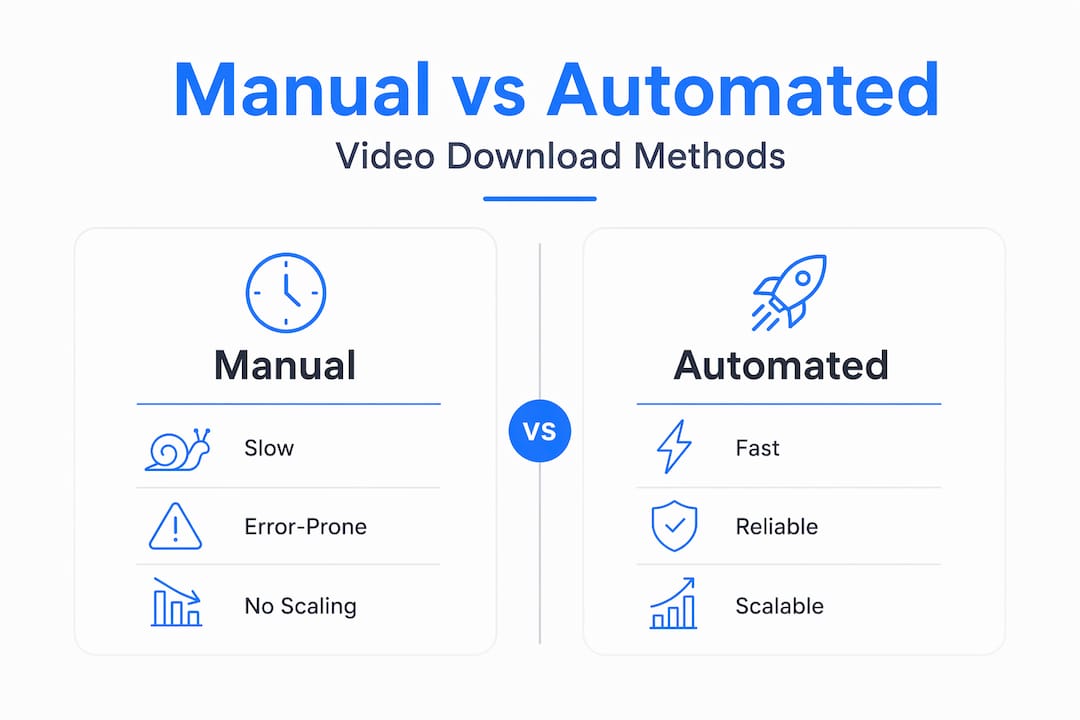
The core issue is that manual downloading scales linearly with human attention. Every clip requires a decision, a click, a wait, and a file check. Double the clips, double the time. That relationship never changes regardless of how disciplined your team becomes. What does change, and not in your favor, is that failure rates compound as volume grows.
A few specific failure patterns show up across teams building AI training datasets manually:
- Naming inconsistency. Without enforced conventions, files arrive named "video(1).mp4
,final_edit_v2.mp4, anddownload(4)_copy.mp4` across the same project. Downstream parsers fail silently. - Resolution drift. Different team members download the same content at different quality settings, and the training pipeline trains on a mix of 720p and 1080p without anyone noticing until evaluation.
- Missing metadata. Subtitles, thumbnails, and chapter data are rarely preserved manually, which means re-extraction later, often after the source has been updated or deleted.
- No resumability. A dropped connection at clip 247 of 600 means starting from the last known good file, assuming you even know which one that was.
"Manual video downloading scales linearly with human attention, becoming a bottleneck for projects requiring 300+ clips where a few failed downloads can consume an entire afternoon."
That afternoon is not wasted on downloading. It is wasted on diagnosing what failed, recovering partial files, and reconciling which clips are actually valid. The maintenance debt accumulates faster than the dataset does.
Technical constraints that hinder manual and simple automated downloads
Even teams that move beyond pure manual methods — using browser extensions or basic scripts — hit a second ceiling quickly. The constraints are baked into platform architecture, not into your tooling choices.
YouTube throttles a single IP after 50 to 100 requests per hour. That number sounds workable until you realize that a modest ML dataset of 2,000 videos represents 20 to 40 hours of throttled wall time from a single IP, assuming zero failures and perfect connection continuity. Neither assumption holds in practice.
File size adds another layer. Video files average 3 to 7GB per hour of 1080p content. A partial download of a 4GB file is not a 3GB usable file. It is zero usable file. Without checksum validation and automated retries, you do not know a file is corrupt until your pipeline tries to read it.

Here is how manual and automated approaches compare on the technical dimensions that matter at scale:
| Capability | Manual download | Browser extension | API-driven extraction |
|---|---|---|---|
| Proxy rotation | None | None | Built-in |
| Retry on failure | Manual | Rare | Automatic |
| Checksum validation | None | None | Standard |
| Parallel transfers | None | Limited | Configurable |
| Metadata preservation | Inconsistent | Inconsistent | Structured |
| Rate limit handling | None | None | Managed |
| Cloud delivery | Manual upload | Manual upload | Direct (S3, R2, GCS) |
The batch downloads guide goes deeper on how these gaps affect real ingestion pipelines, but the table above captures the core problem: everything above "manual upload" in that last row requires infrastructure that manual processes simply do not have.
Pro Tip: Checksum validation is not optional for ML datasets. A file that looks complete but has a corrupted final segment will often pass basic file-size checks and fail only at training time, which can cost hours of GPU compute before anyone identifies the root cause.
The challenges of manual video downloads are not solved by switching from a browser to a script. They are solved by treating video acquisition as an infrastructure problem, not a file management problem.
Operational and legal complexities of manual video downloading at scale
The technical ceiling is frustrating. The legal ceiling is materially worse. Most AI product teams underestimate how quickly manual downloading at scale crosses from operational inconvenience into legal exposure.
When a video is downloaded manually outside a platform's delivery system, play counts and revenue attribution freeze entirely. The platform's content ID system, royalty tracking, and creator analytics all depend on in-system delivery. Bypassing that system is not a side effect of downloading. It is the mechanism by which downloading works. This matters because platforms operating in a $191.55 billion market have strong financial and legal incentives to enforce those boundaries.
The legal risk compounds at scale. Manual scraping for video datasets creates governance exposure that grows with every clip added. A federal court has found that YouTube's rolling cipher qualifies as an access control measure under DMCA Section 1201(a), meaning circumvention can create liability independent of copyright infringement itself. Your team does not need to redistribute a single video to face legal risk. Bypassing the delivery mechanism is the act.
The operational risks are easier to address but equally damaging to project timelines:
- No audit trail. Manual downloads leave no structured log of what was acquired, when, from which source, or by whom. Reproducing a dataset months later for model validation is effectively impossible.
- No access control. Files saved to shared drives get renamed, moved, and deleted without version history, especially on fast-moving teams.
- No observability. You cannot monitor failure rates, retry patterns, or throughput because none of that data exists. You find out something went wrong when the pipeline breaks.
- Platform enforcement escalation. As platforms tighten access controls, the same manual approach that worked six months ago fails today without warning or diagnostic information.
Governance requirements for AI training data are tightening, not loosening. The EU AI Act's data provenance requirements and US copyright litigation trends around training data both push in the same direction: you need to document what you collected, how, and under what terms. Manual downloads cannot produce that documentation reliably.
Good video dataset legal guidance factors in both the technical and governance dimensions from the start, not as an afterthought.
How automated workflows and APIs enable scalable, reliable video extraction
The gap between manual video downloading and a production-grade extraction pipeline is not primarily about speed. It is about replacing a linear, human-dependent process with a system that handles failure, maintains consistency, and produces auditable outputs.
The best extraction workflows resemble operations systems: they have queues, validation steps, rollback capability, and post-download tagging. That architecture is what makes them repeatable. Repeatability is what makes them trustworthy for ML pipelines where dataset reconstruction needs to be feasible months after initial collection.
The key capabilities that automated systems add over manual methods:
- Proxy rotation handles platform rate limits and geoblocking without manual intervention or IP rotation management by your team.
- Automated retries with checksum validation ensure every file in your dataset is complete and verified before it touches your storage layer.
- Consistent metadata embedding captures subtitles, thumbnails, chapter markers, and resolution data at acquisition time, not as a separate pass later.
- Direct cloud delivery to S3, R2, GCS, or Azure eliminates the manual upload step entirely and supports immediate pipeline ingestion.
- Structured logging produces the audit trail that governance and compliance require.
The reason video ingestion is 90% plumbing, specifically proxies, retries, and validation, versus 10% actual downloading is that platforms are actively adversarial to extraction at scale. Anti-bot systems, rolling ciphers, and session management changes are not edge cases. They are the normal operating environment.
Automated tools like yt-dlp embed subtitles, thumbnails, and metadata by default, which matters enormously for downstream ML pipelines where re-extraction is expensive. But yt-dlp still requires you to manage the proxy layer, handle rate limits, run your own infrastructure, and maintain the tool as platforms update their delivery mechanisms. The best YouTube downloader APIs in 2026 take that entire maintenance surface off your team's plate.
For teams building video training datasets, the decision to move from manual to API-driven extraction is almost always made twice: once as a plan, and once in production after the manual approach has already caused a significant incident.
Why the "good enough for now" framing is the most expensive position
Here is the framing that costs teams the most time: treating manual downloading as a temporary phase. The assumption is that once the dataset is large enough to justify the investment, the team will migrate to a proper extraction infrastructure. What actually happens is different.
Manual downloading does not just slow down data collection. It actively degrades the dataset while the team is unaware. Resolution inconsistency, missing metadata, and unverified files accumulate silently. By the time the team decides to invest in proper tooling, they are not building on top of prior work. They are cleaning it up, often completely re-collecting.
The tipping point is not at 10,000 clips. For most AI product teams, the challenges of manual video downloads become production-blocking somewhere between 300 and 800 clips, which is early in any serious dataset project. The cost of the manual phase is not just the time spent downloading. It is the cost of everything built on top of data that cannot be verified.
Improving video download scalability is not a future optimization. It is a precondition for any dataset that needs to grow, be reproduced, or be audited. Teams that treat it as infrastructure from day one build faster, not slower.
Build on extraction infrastructure, not extraction workarounds
If your team is currently managing proxy rotation, retry logic, format normalization, and cloud delivery as separate concerns across different tools, you are running infrastructure that was designed to solve one problem and inherited by a team trying to solve a different one. That is the definition of a workaround.
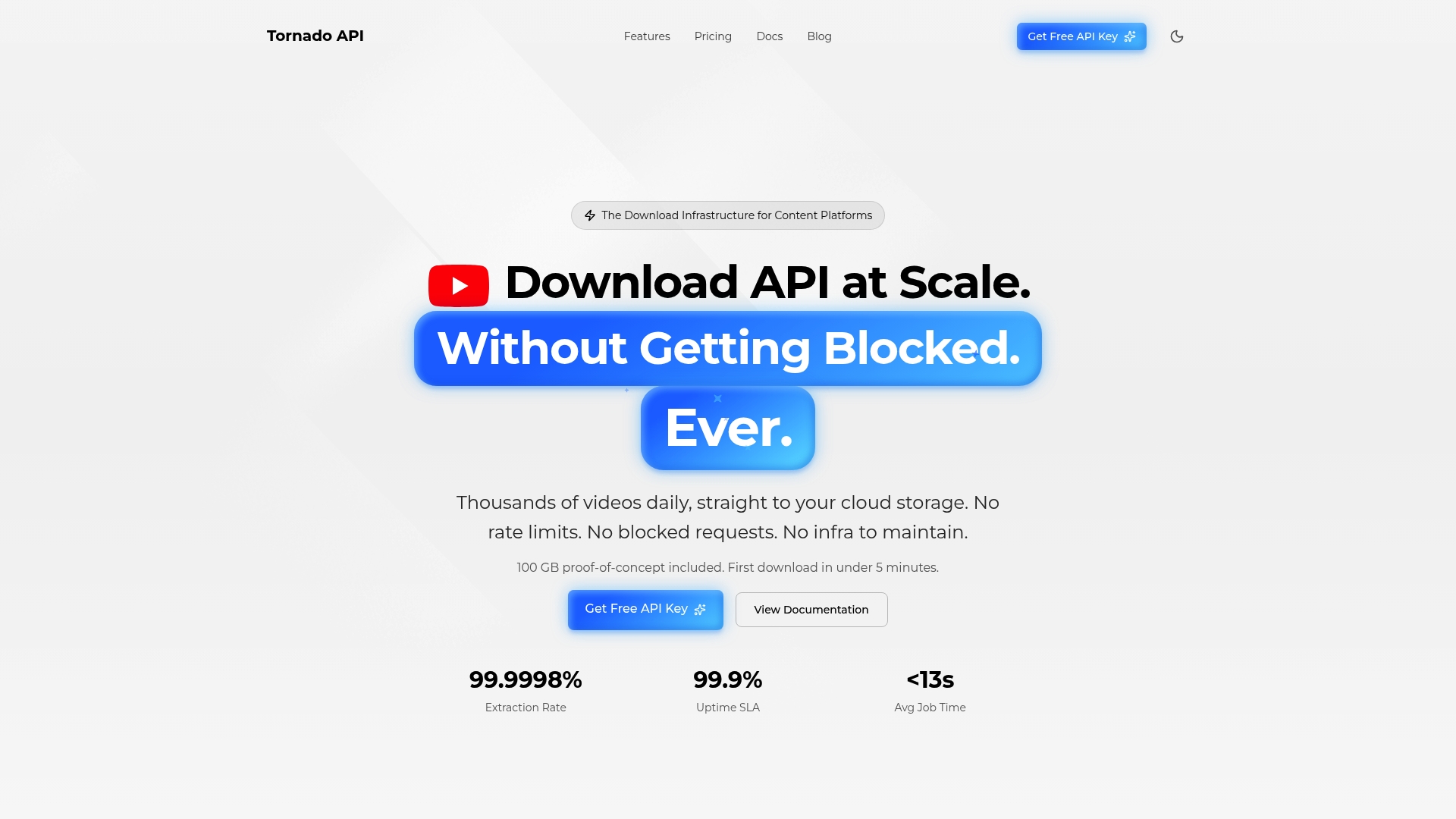
TornadoAPI sits between YouTube, Spotify, Instagram, TikTok, and your training pipeline. One API call handles anti-bot systems, proxy rotation, format normalization, and direct delivery to S3, R2, GCS, or Azure. We deliver 300 TB per month at 99.998% extraction reliability with 50 Gbps capacity, backed by a contractual SLA, not a toolbox you manage. Frontier AI labs, transcription SaaS platforms, and podcast companies replaced their self-managed extraction stacks with TornadoAPI because the maintenance overhead was eating engineering time that belonged in the product. If that matches where your team is, book an infra-to-infra call with the team at Velys Software.
Frequently asked questions
Why does manual video downloading become a bottleneck for large projects?
Manual downloading depends entirely on human attention, so it scales linearly with volume rather than with compute. Projects requiring 300 or more clips regularly see a few failed downloads consume entire afternoons, blocking all downstream work.
How do platform rate limits impact manual video downloads?
YouTube throttles single-IP requests after 50 to 100 per hour, meaning any manual or basic automated process hits a hard ceiling that proxy rotation is specifically designed to work around.
What legal risks are associated with manual video downloading at scale?
A federal court found that YouTube's rolling cipher qualifies as an access control measure under DMCA Section 1201(a), so circumventing it at scale creates liability exposure even without redistributing any content.
Why do AI teams prefer automated video extraction workflows over manual methods?
Automated workflows with queues and validation produce verifiable, reproducible datasets with structured logs, metadata, and retry guarantees that manual processes fundamentally cannot replicate at any meaningful volume.