
How API-Based Video Access Works for Developers
API-based video access is the architecture that separates viewer authentication from video delivery, using short-lived signed URLs and CDN edge validation to control who watches what and when. Understanding how API video access works is not optional for developers building any video product in 2026. Whether you are integrating with Mux, AVCaption, or a custom streaming stack, the same core pattern applies: your backend authenticates the user, issues a token, and the CDN enforces access on every single media request. This article breaks down each layer of that system with enough technical depth to implement it correctly.
How does the API-based video access flow work?
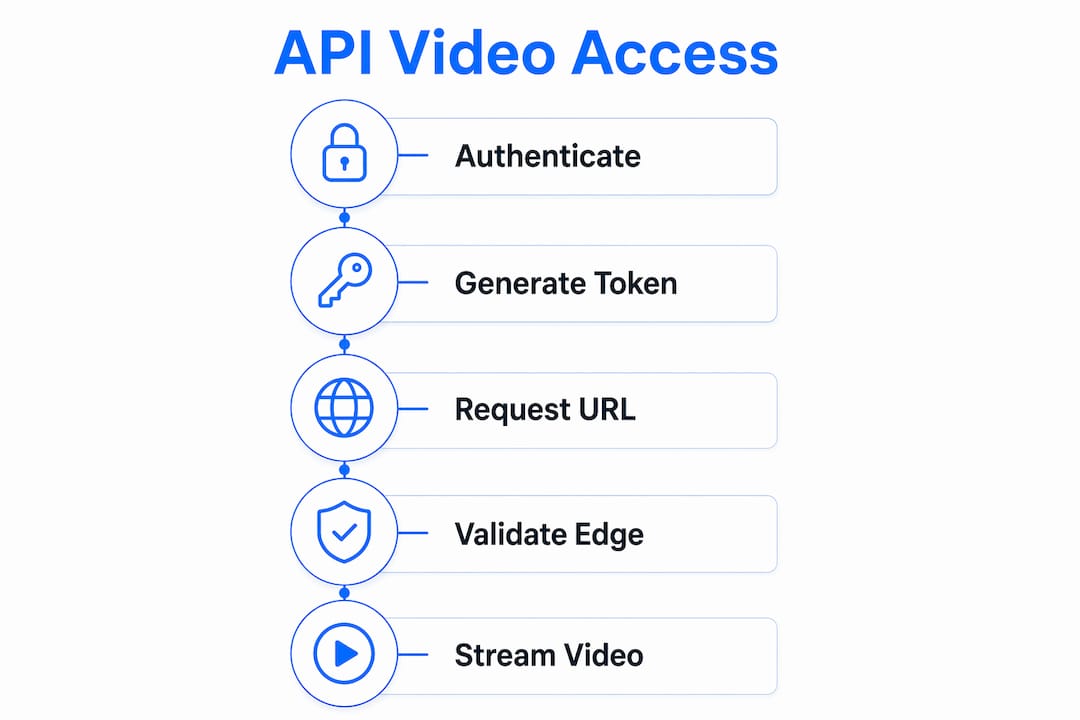
The end-to-end flow of API-based video access follows a predictable sequence, but each step carries implementation decisions that affect security and reliability. Here is how the full cycle runs from user request to video playback:
- User authentication. Your backend verifies the user's identity and access rights. This is standard session or OAuth-based auth. Nothing video-specific happens yet.
- Token or signed URL generation. The backend calls your video API (or your own signing logic) to generate a short-lived signed URL or JWT token scoped to that viewer and that asset.
- Client requests the streaming manifest. The video player, using the signed URL, fetches the HLS ".m3u8
or DASH.mpd` manifest from the CDN or origin. - CDN edge validates the signature. On every segment request, the CDN checks the token's cryptographic signature, expiry, and any IP or domain constraints before serving the media bytes.
- Playback proceeds or is denied. A valid token returns the segment. An expired or tampered token returns a
403 Forbidden. No exceptions.
The critical distinction from traditional login-gated pages is where authorization happens. Signed URLs push authorization from the application layer to the CDN edge, validating each stream request instead of once at page load. A session cookie that grants page access does nothing to stop someone from copying a direct media URL and sharing it. Edge validation closes that gap entirely.
Pro Tip: Never generate signed URLs on the client side. The signing secret must stay on your backend. If it leaks, every signed URL you have ever issued is compromised.

What streaming protocols are involved in API video delivery?
Streaming protocols define how video bytes travel from the CDN to the player, and they directly affect how you structure token validation.
HLS (HTTP Live Streaming) is the dominant protocol for on-demand and live video. The player fetches a master manifest listing available bitrate variants, selects one, then downloads a sequence of short media segments. HLS segments run 2 to 6 seconds in standard mode, with the live playlist updating dynamically as new segments are published. Each segment is a discrete HTTP request, which means each one can be individually validated at the CDN edge.
DASH (Dynamic Adaptive Streaming over HTTP) follows the same segment-and-manifest model but uses an .mpd file instead of .m3u8. DASH is codec-agnostic and widely supported in browser-based players. For token validation purposes, DASH and HLS behave identically: the CDN checks the token on every segment fetch.
Low-Latency HLS (LL-HLS) changes the calculus. LL-HLS uses partial segments of roughly 200 to 500 milliseconds and progressive playlist delivery to achieve 2 to 5 second latency. That means your tokens must cover a much higher request rate, and expiry windows need careful calibration to avoid cutting off an active viewer mid-stream.
| Protocol | Segment size | Latency | Token pressure |
|---|---|---|---|
| HLS (standard) | 2 to 6 seconds | 6 to 30 seconds | Low |
| DASH | 2 to 4 seconds | 6 to 20 seconds | Low |
| LL-HLS | 200 to 500 ms | 2 to 5 seconds | High |
Robust HLS security requires protection of master playlists, variant playlists, and all segments, with edge validation on each request. Protecting only the manifest while leaving segments open is a common and costly mistake.
How are signed URLs and tokens generated and validated?
Signed URLs use HMAC-SHA256 signatures over request fields including the URL path and expiry timestamp. The CDN holds the same shared secret and recomputes the signature on every incoming request. If the signatures match and the token has not expired, the segment is served. If not, the CDN returns 403 Forbidden without touching the origin server.
JWTs (JSON Web Tokens) add a structured payload to this model. A well-formed video JWT includes:
exp: Unix timestamp for expiry, typically 1 hour for on-demand contentsub: Viewer or session identifier for audit loggingaud: Asset ID or stream identifier to prevent token reuse across different videosipordomain: Optional binding to reduce replay attack surface
The alternative to signed URLs is opaque embed tokens, which are short random strings that map to access rules stored server-side. Opaque tokens are easier to revoke instantly because you delete the server-side record. Signed URLs require a revocation list at the CDN edge, which platforms like Akamai support through revoked token lists for segmented content.
| Mechanism | Revocation speed | Stateless | Best for |
|---|---|---|---|
| Signed URL (HMAC) | Requires CDN revocation list | Yes | High-volume, stateless delivery |
| JWT with claims | Requires CDN revocation list | Yes | Per-viewer entitlement |
| Opaque embed token | Instant (delete server record) | No | Subscription or DRM content |
Pro Tip: Separate your backend API credentials from your playback signing keys. A leaked API key gives an attacker write access to your video library. A leaked signing key only compromises playback URLs, which expire anyway.
Per-session tokens with explicit TTLs align playback entitlement with session lifetime. The standard workflow is: generate token, embed in player config, let it expire, regenerate on refresh. This keeps your authorization surface minimal and auditable.
What developers must know before integrating video APIs
Practical integration of video APIs introduces operational concerns that go beyond the cryptographic basics.
- Token lifetime alignment. A token that expires in 5 minutes will interrupt a 90-minute movie. Set TTLs to match your longest expected playback session, or implement a token refresh endpoint the player calls before expiry.
- LL-HLS token refresh. Token refresh mid-playback is required for low-latency streaming to maintain continuous authorization. Tokens must cover both playlist prefetching and segment delivery duration. Build the refresh logic before you go live, not after your first production incident.
- Credential separation. Separate backend API authentication from viewer playback authorization via short-lived tokens. Your backend uses long-lived API keys to manage assets. Viewers get short-lived playback tokens. These two credential types should never share the same key material.
- Rate limit handling. Video REST APIs use standard HTTP methods with API key or OAuth authentication. Every token issuance call counts against your rate limit. Cache tokens for active sessions rather than regenerating on every page load. The Tornadoapi blog covers video platform rate limit fixes in production detail.
- ACL path alignment. Mismatch between ACL path constraints and actual manifest URLs causes playback failures. Your access control policy must match the exact resource paths your player requests, including query parameters and trailing slashes.
- Token revocation at scale. For subscription products, you need a revocation mechanism that fires when a user cancels or is suspended. Opaque tokens win here. If you use signed URLs, your CDN must support a revocation list and you must push updates to it in near real time.
The cleanest architecture keeps the video player completely unaware of your business logic. The player receives a signed URL or token. It plays video. Your backend handles all entitlement decisions before that URL is ever issued.
Key takeaways
API-based video access works by moving authorization from the application layer to the CDN edge, where every media segment request is validated against a short-lived cryptographic token before any bytes are served.
| Point | Details |
|---|---|
| Edge validation is the core mechanism | CDN validates signed URLs or tokens on every segment request, not just at page load. |
| Token TTL must match playback duration | Short-lived tokens that expire mid-stream cause playback failures; align TTL to session length. |
| Separate API keys from playback tokens | Backend credentials and viewer signing keys must use different key material to limit breach impact. |
| LL-HLS demands token refresh logic | Partial segments at 200 to 500 ms require mid-playback token refresh to avoid interruption. |
| Opaque tokens enable instant revocation | Unlike signed URLs, opaque tokens can be invalidated immediately by deleting the server-side record. |
Why edge authorization is the only architecture worth building on
I have reviewed enough video integrations to say with confidence that most security failures in streaming products are not cryptographic failures. They are architectural ones. Teams protect the page. They forget the segments.
The shift from page-level session auth to CDN edge validation is not a minor optimization. It is a fundamentally different trust model. When authorization lives at the edge, a stolen URL is worthless after expiry. When it lives at the application layer, a stolen session token can stream indefinitely. I have seen production systems where a logged-out user could still stream content for hours because the CDN had no idea the session was revoked.
The emerging pressure from AI video pipelines makes this more urgent, not less. AI labs and transcription platforms are ingesting video at scale, and the attack surface for unauthorized bulk access has grown proportionally. Edge manifest rewriting with injected signed segment URLs is one approach that tokenizes delivery without requiring application changes, but it demands careful cache and expiry coordination.
My honest recommendation: unless your team has deep CDN and token infrastructure experience, use a platform that manages token issuance and edge validation for you. The cryptography is not the hard part. The operational discipline around key rotation, revocation lists, and TTL alignment is where teams consistently underestimate the work.
— Alexandre
How Tornadoapi handles video extraction at production scale
Tornadoapi is the video extraction infrastructure built for AI teams, transcription platforms, and frontier labs that need video at scale without managing the extraction stack themselves. One API call handles anti-bot systems, proxy rotation, format normalization, and direct delivery to S3, R2, GCS, or Azure. The platform delivers 300 TB per month at 99.998% extraction reliability with 50 Gbps capacity. If your pipeline pulls from YouTube, TikTok, Instagram, or Spotify, the YouTube Downloader API gives you production-grade access without building or maintaining the infrastructure. For teams moving bulk video into cloud storage directly, the direct cloud export API handles authenticated delivery end to end.
FAQ
What is API-based video access?
API-based video access is a system where a backend authenticates users, issues short-lived signed URLs or tokens, and a CDN validates those tokens on every media segment request before serving video bytes.
How does a signed URL secure video streaming?
A signed URL embeds a cryptographic HMAC-SHA256 signature over the URL path and expiry timestamp. The CDN recomputes the signature on each request and returns 403 Forbidden if the signature is invalid or expired.
What is the difference between signed URLs and embed tokens?
Signed URLs are stateless and validated cryptographically at the CDN edge. Opaque embed tokens map to server-side records and can be revoked instantly by deleting that record, making them better for subscription or access-controlled content.
Why does LL-HLS require special token handling?
Low-latency HLS uses partial segments of 200 to 500 milliseconds, which generates a much higher rate of CDN requests. Tokens must cover both playlist prefetching and segment delivery, and mid-playback token refresh logic is required to prevent interruption.
How should developers separate API credentials from playback tokens?
Backend API keys manage asset operations like uploading and transcoding. Viewer playback tokens are short-lived and scoped to a single asset and session. These two credential types must use separate key material so a leaked playback token cannot grant write access to your video library.